15.6″ FHD Laptops with AI Assistant Included, Quad-Core
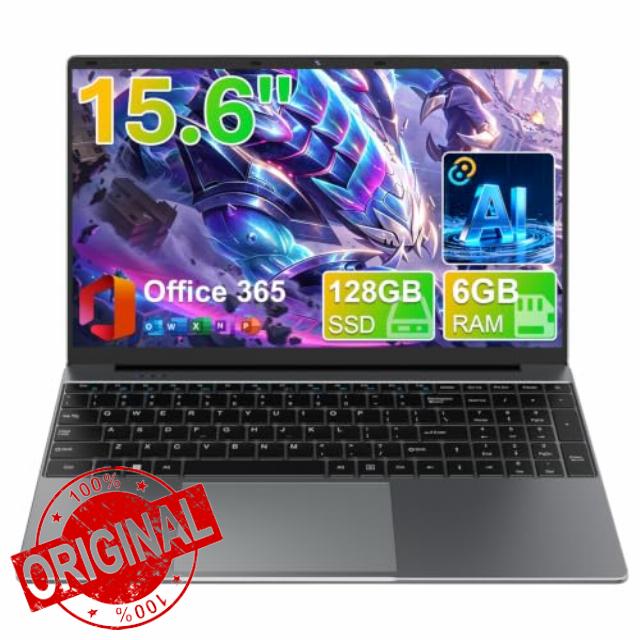
15.6″ FHD Laptops with AI Assistant Included, Quad-Core Processor 1 Year Office 365, 6GB RAM 128GB SSD, 180°Viewing, USB-C, 1920×1080, 53.2Wh, for Business and Stude
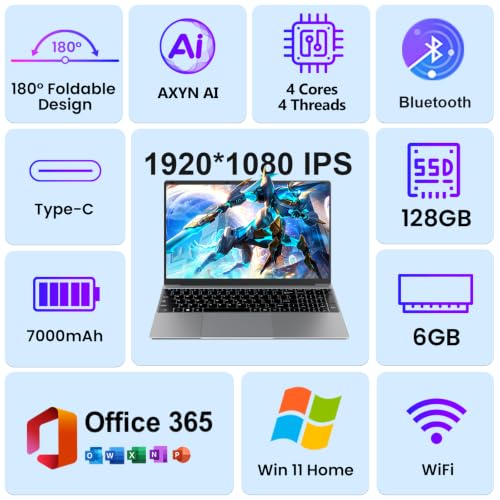
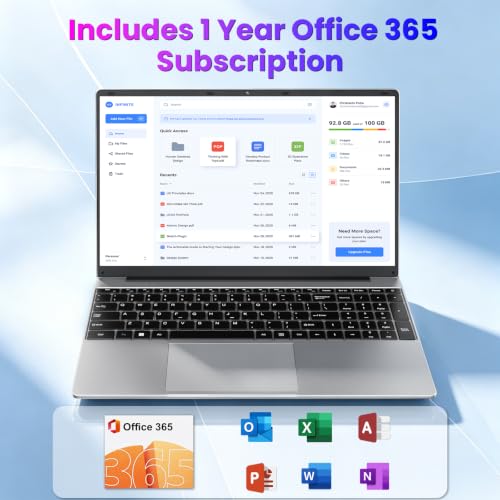
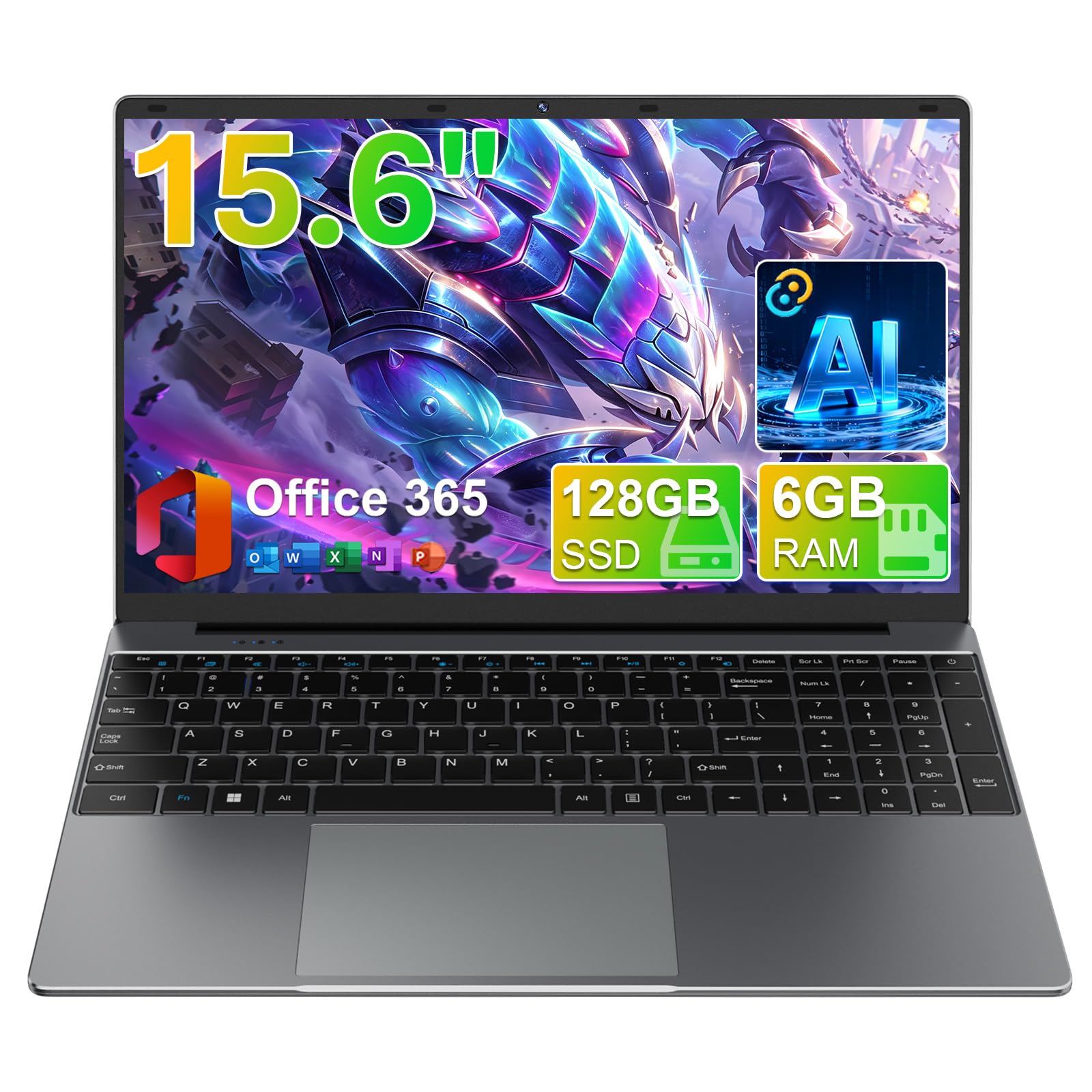
- AI Assistant Included & Office 365: Laptop built-in AI features come in five modes: Chat, Write, Read, Meet, and Draw—helping you handle all your tasks, saving you time, and boosting your efficiency. It’s always there for you. Plus, it comes with a 1-year Office 365 subscription pre-installed, providing maximum support for your work
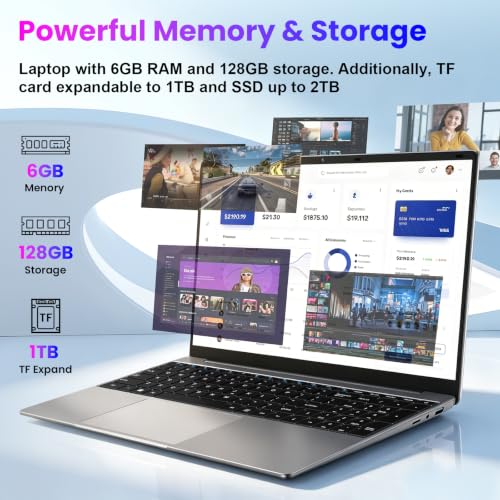
- Power Meets Room: Powered by a Celeron J4105 quad-core processor, 6GB RAM, and a 128GB M.2 SSD, this laptops handles daily tasks with ease. Expand storage up to 2TB via SSD or 1TB via TF card. Smooth performance, plenty of room – for work, study, or play
- Full HD Visuals: Featuring a 15.6" FHD Laptops display with 1920×1080 resolution, this laptop delivers vivid colors and sharp details. Its ultra-narrow bezels maximize the screen real estate, offering an immersive viewing experience that makes every image feel lifelike
- 180° Lay-Flat Design: The laptop's hinge can open up to 180 degrees, further enhancing its flexibility and allowing you to adjust the viewing angle as needed—whether you're giving a presentation, collaborating on a brainstorming session, or simply looking for the most comfortable viewing angle
- Multiple Port Selection: Laptop computer supports Wi-Fi 5 and Bluetooth 4.2, providing fast and stable wireless connectivity. Also equipped with multiple ports: Type-C port, USB 3.2, Mini-HDMI for all your daily needs, best choice for your office or life
From the brand



| SKU: | B0HCB7G1LQ |
| Weight: | 3.7 pounds |
| Size: | 6 GB |
| Brand: | BTDD |
| Model: | M156FH |
| Colour: | Light Grey |
| Batteries Included: | Lithium Ion |
| Manufacture: | BTDD |
| Colour: | Light Grey |
| Size: | 6 GB |
From the brand





Decent budget worker, but keep your charger handy!
I picked up this BTDD 15.6-inch laptop primarily for daily office work, web browsing, and some light multitasking. For the price point, it’s a capable machine, but there are a few important tradeoffs you should know before buying.
Performance & Storage
The Core i7-9750H processor is a few generations old now, but because it has 6 cores, it still handles everyday tasks like a champ. It boots up incredibly fast thanks to the 256GB SSD, and opening 15+ Chrome tabs while editing a Word document didn’t cause any stuttering.
Note on Storage: If you plan on downloading a lot of large software or storing tons of video files, that 256GB SSD will fill up quickly. You may want to look into an external drive or cloud storage.
Display & Build
The 1080p FHD screen is sharp, and the 180 hinge is actually super convenient when you want to lay the laptop completely flat on a desk to share your screen with a classmate or coworker. The backlit keyboard feels comfortable to type on, which is a massive plus if you’re writing long essays or reports late at night.
The Catch: Battery Life
The main drawback here is the 5000mAh battery. Combined with an older, power-hungry i7 processor, the battery life is pretty underwhelming. I averaged about 3 to 4 hours of continuous use (medium brightness, streaming music, and typing) before needing a plug. If you’re a student running from class to class all day, you will definitely need to pack the charger.
Quick Pros & Cons
Pros:
Very snappy performance for standard business/school apps.
Keyboard backlight makes night typing a breeze.
Good port selection, including Type-C.
Crisp display with excellent viewing angles.
Cons:
Short battery life (plan on staying near an outlet).
256GB storage is a bit tight by modern standards.
Final Verdict
If you need an affordable laptop for a desk-bound setup, a home office, or dormitory use where an outlet is always nearby, this is a fantastic value. If you need true all-day portability without a charger, you might want to look elsewhere.
Good Entry Level Laptop
This device is suitable as the initial laptop for your son or daughter. It is equipped with fundamental components, including an Intel Core i7 processor, 8GB of DDR4 RAM configured as two 4GB modules, and a 256GB NVMe SSD. Please note that these specifications represent the minimum available options, which are reflected in the economical price of $350. In comparison, the newly released Mac Neo begins at $699, rendering this an economical and suitable starter device. Its 15-inch display is also a noteworthy feature. While the internal specifications are minimal, they are sufficient for a student’s typical activities such as composing papers, browsing the internet, and managing emails. Nevertheless, a 256GB NVMe SSD can become quickly filled, as Windows software alone may require between 100GB and 130GB of storage, leaving approximately half of the drive available for files and applications. It is advisable to consider an immediate upgrade to the NVMe drive to ensure ample storage capacity for future needs.
Very good
I really like this laptop. It is very practical for work and runs quickly. The screen is a good size and comfortable to work with. So far, I am very satisfied with the product, and it has proven very useful for my daily tasks.
Really nice laptop for everything except hardcore gaming
I will try to be as thorough as I can on this review. But if you don’t want to read this entire review, the summary is that I highly recommend this laptop for most of the day to day uses you may need to do with a laptop.
Picked up this laptop and got it set up. Set up was super easy which was basically setting up Windows access. It comes with a one month Office 365 subscription but then it bumps to $99 a year after that (nothing to do with the laptop, but wanted to mention it).
Is this a hard core gaming rig? No. It has 8GB RAM (and the OS will take half of that) and 256GB disk. The CPU is decent for day to day use. The display is 1920×1080 so it is great for basic things like watching a movie, checking email or social media and playing some games. Will it run Call of Duty at a high FPS? No. But for basic gaming it worked well. I tried some basic Steam games and it worked fine.
It has a nice assortment of USB ports as well as an HDMI connector and a wired LAN connector which is very nice when using this on a desktop. The WiFi and bluetooth are solid. No issues at all connecting to my ear buds and home WiFi.
A few comments.
The camera is not IR so it will not do Windows Hello face recognition. You have to set up fingerprints and/or PIN. Not a huge deal IMO. A face recognition is nice, but not required. The camera is not a super high resolution but good enough for a Zoom call for sure.
It does not have a touch screen. But it has a nice trackpad and enough USB ports you can run a mouse dongle.
The cooling fans are under the laptop (which is standard on laptops these days) so if you are using it on your lap for anything graphically intensive like gaming you may need a cooling pad otherwise it will cook your legs. Again, not a big deal since pretty much all laptops are set up this way these days.
It does not come with any media for the OS. I want to try a Linux build but if I do that, I will need to find a Windows 11 boot. Not sure about the licensing for Windows if I do that.
I am not sure the price of this rig. When I grabbed it the Amazon price was $350’ish which would be a nice price for a laptop like this. It would be something very nice for a younger user or an older user that wants to use social media and such. Or even a work laptop for email/Slack/zoom whatever.
So, I highly recommend this rig for anything but really hardcore gaming performance.
Decent laptop for the price with Windows 11 Pro and barely sufficient RAM and storage but upgradable. The CPU is an older generation but still performs reasonably well for everyday work. Battery life is mediocre, the chassis is all plastic and feels a bit cheap, and the touchpad click is the weakest part of the machine. The 8GB it ships with is on the low side for Windows 11, and upgrading the memory makes this a much more useful laptop. RAM and SSD are both upgradable, but there are no instructions in the box and none I could find online, so I worked out the disassembly myself and wrote it up below with pictures.
Detailed Review:
Performance is reasonable for the price. The Core i7-9750h is a previous generation cpu from 2019. That said, it’s a respectable 6 core CPU and it handles normal daily work well provided enough RAM and SSD. For browsing and general use it performs reasonably well out of the box. If, however, you want to do a bit more with this I’d highly recommend upgrading the RAM and SSD storage.
Windows 11 Pro is worth noting. Many systems/laptops at this price ship with Home, and Pro gets you additional features like BitLocker, Remote Desktop hosting, and group policy. If any of that matters to you, it’s real money you’re not spending separately.
Battery life is mediocre. I didn’t expect anything stellar at this price and it matches my expectations. Worth noting that the battery is listed as 5000mAh which isn’t very big for a 6 core cpu at full speed. Cooling fans needed for this cpu reduce runtime even more.
The chassis is all plastic and feels somewhat cheap. It isn’t terrible but it’s plastic so it’s no macbook but then you’re not gonna get a macbook at under $400 either.
The touchpad is where things get a little more obviously deficient. The click action is very firm and doesn’t feel responsive so double clicking is kind of a coin flip.
Upgrading the RAM and SSD is easier said than done. The 8GB of stock memory is a bit low for Windows 11. It works, but 8GB is about as low as you’d want for an Windows 11 system and adding memory is what turns this from adequate into a much more useful machine. Both the memory and the SSD are upgradable, and the listing advertises support for far up to 32GB of RAM but there are no upgrade instructions in the box, and surprisingly, I could not find any online either. No service manual, no teardown guide, nothing. For a machine where upgrade unlocks it’s full potential, the lack of printed or online upgrade instructions is a real gap.
After some trial and error I was able to open the chassis and do the upgrade so I thought I’d share my process for others in case it helps:
1. Turn the laptop upside down and locate the screws on the bottom.
2. There are several different sizes, so make sure to keep note of which screws go where. I laid them out in the same pattern as the case and took a picture so I could identify which screw went where during reassembly.
3. Take a thin metal spudger, or a butter knife in a pinch, and gently pry the bottom panel away from the main body. I started at the front right corner near the model label and worked slowly across the edge, along the side away from the hinge.
4. Watch for the magnets that hold the lid shut. They will grab a metal spudger.
5. There are about 6 tabs along the long side. You need to pry the side away from the panel slightly to release them.
6. Once you get around the corners, the remaining tabs unclip with a slight bit of pressure.
7. Memory and SSD are easily accessible once the bottom panel is off.
It isn’t hard but since the chassis is plastic scratching or breaking parts is possible so work slowly and carefully without too much force.
Suggestions for the manufacturer: First, replace the touchpad with one that has separate left right buttons instead of the clickable pad. Second, publish an upgrade guide or post a video to help people upgrade.
Overall this is a decent machine for the money. Older CPU that still gets the work done, Windows 11 Pro included, unremarkable battery, plastic build, a touchpad click I’d change, and genuinely upgradable internals once you know how to get inside. Budget for a memory upgrade and it becomes a considerably more useful laptop than it is out of the box.
I needed a computer to use as a jump box, and this one has been a very affordable option. It has all the basic functionality I need, plus quite a few modern features such as an SSD, Windows already installed, built-in Wi-Fi, and Bluetooth. Those features make it very convenient, and compared with many of the typical options used as jump boxes, this machine is honestly significant overkill for the job.
The only downside for me is the limited selection of standard ports. I would have preferred a more universal charging port, along with traditional USB-A and Ethernet ports. Using a hub adds another moving part to the setup.
That said, considering the other jump-box options I could afford, I really have nothing to complain about.