4TB NVMe SSD M.2 2280 PCIe Gen4 for PS5 Expansion 7300MB/s

4TB NVMe SSD M.2 2280 PCIe Gen4 for PS5 Expansion 7300MB/s Internal Gaming SSD with 3D TLC NAND for PlayStation 5 Expansion,PC, Laptop
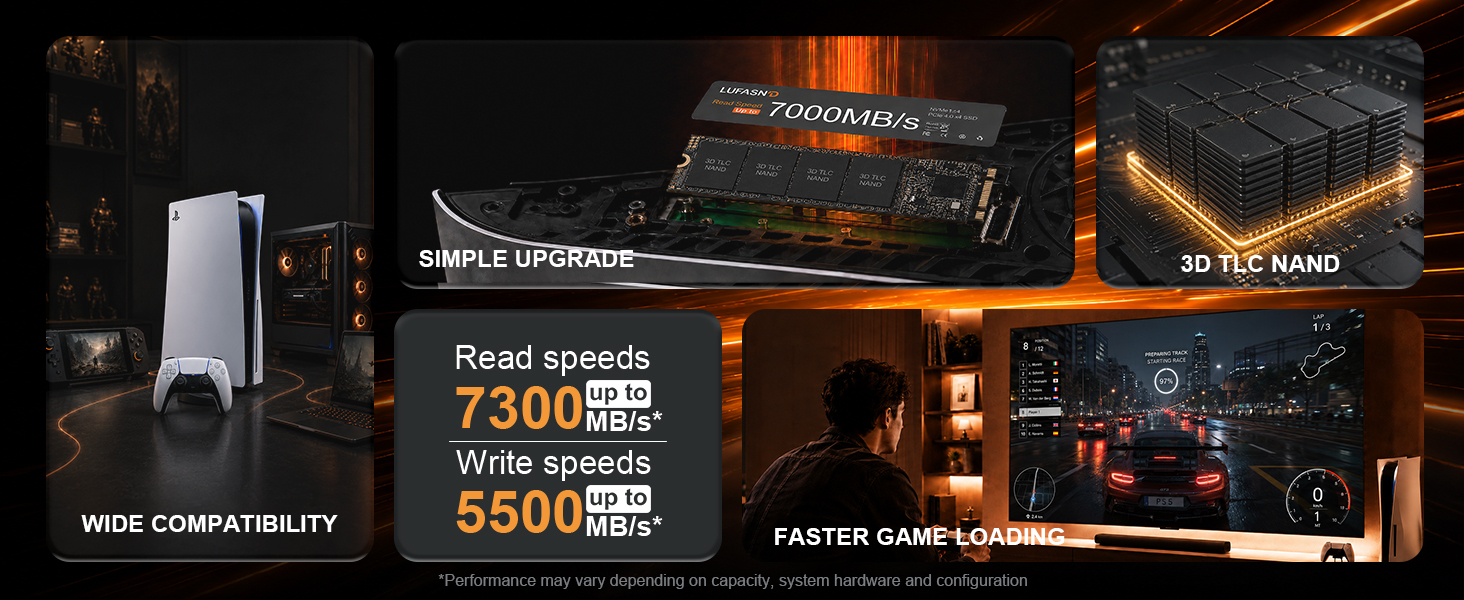
- Blazing PCIe Gen4 Speed – Powered by PCIe Gen4x4 technology, the LUFASND NVMe M.2 2280 SSD delivers sequential read speeds up to 7000MB/s and write speeds up to 5000MB/s for lightning-fast performance. Experience shorter boot times, faster game loading, rapid file transfers, and smoother multitasking whether you're gaming, creating content, or handling demanding workloads.
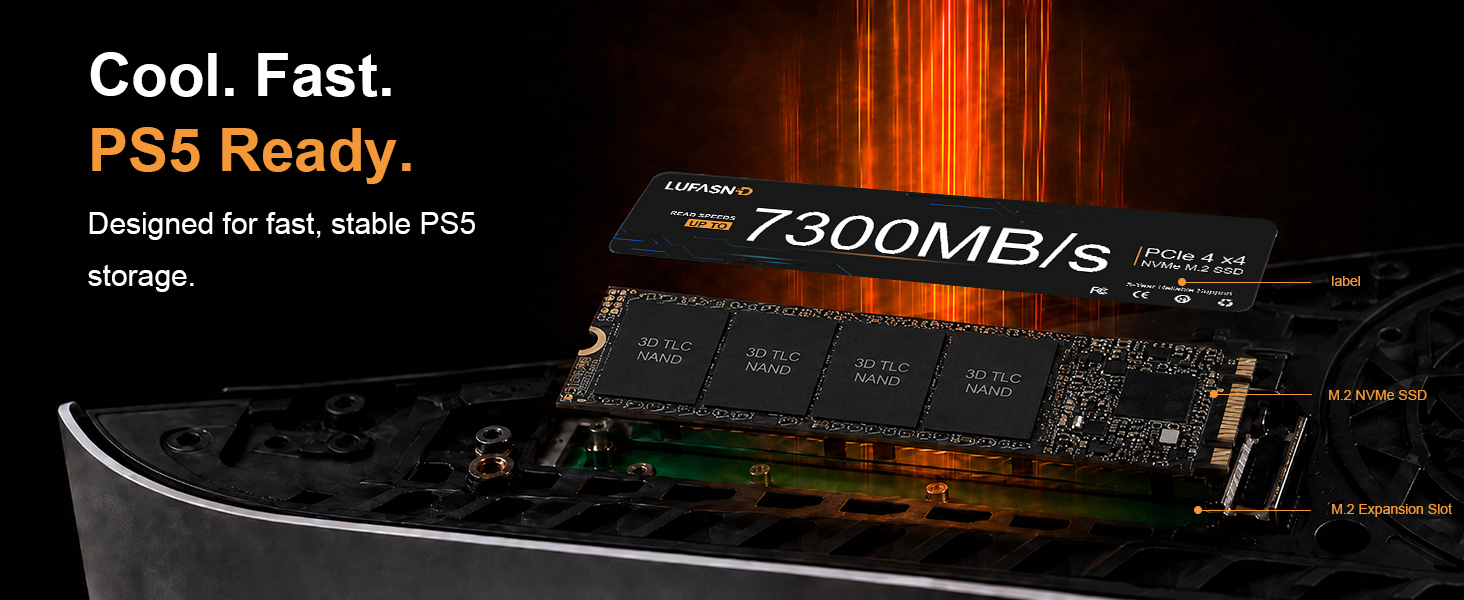
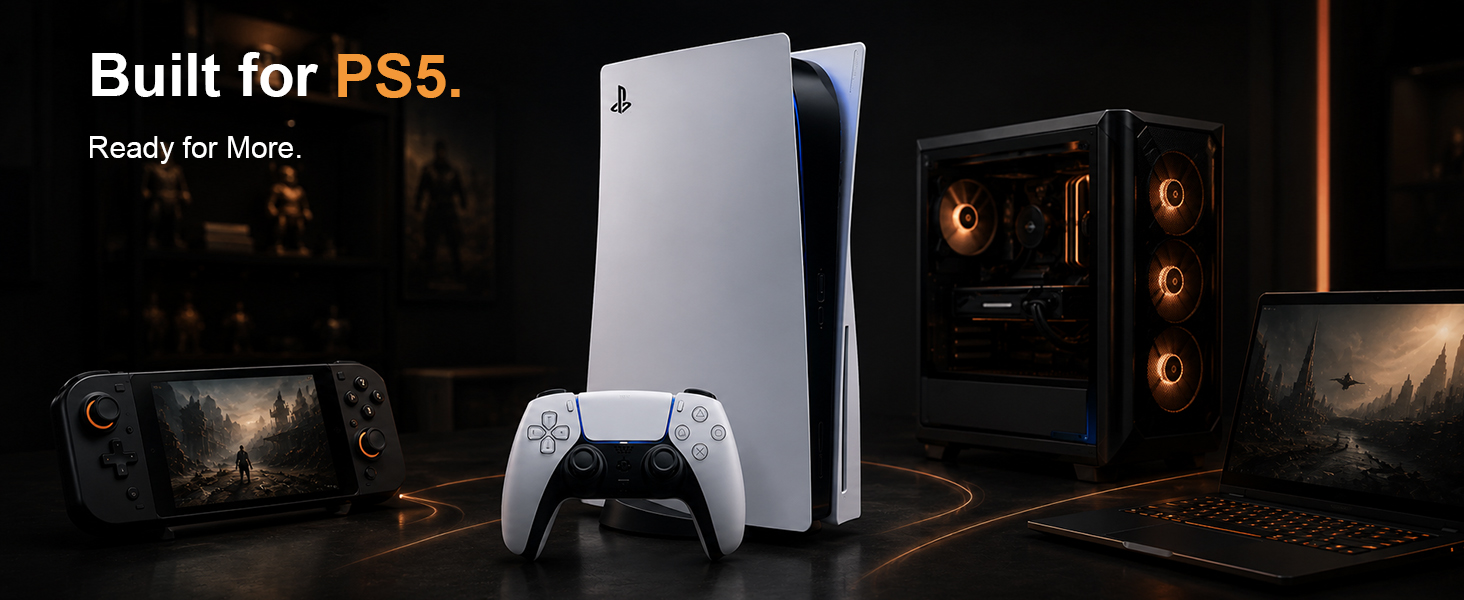
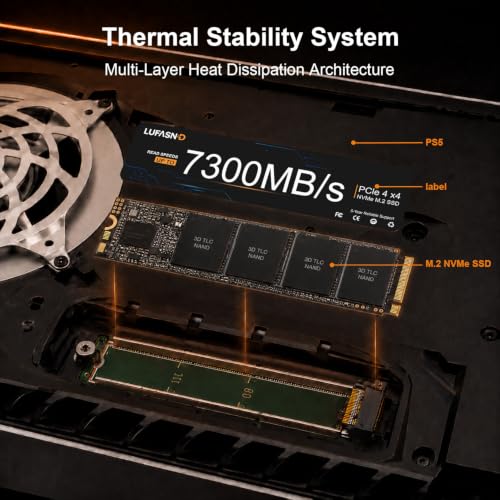
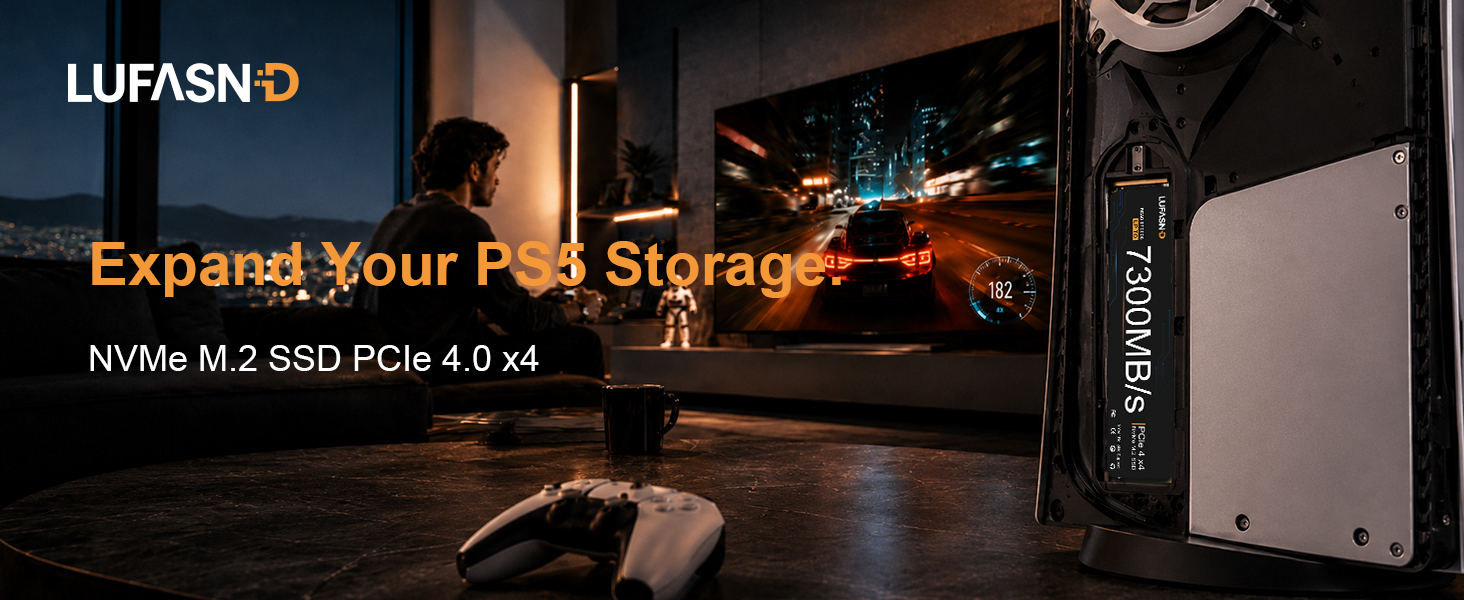
- Designed for PS5 Storage Expansion – Built for PlayStation 5 storage expansion, this PCIe Gen4 NVMe SSD meets PS5 performance requirements for smooth gameplay and ultra-fast load times. Store more AAA games and enjoy a seamless gaming experience. Also compatible with gaming PCs, laptops, and desktops for high-performance upgrades.
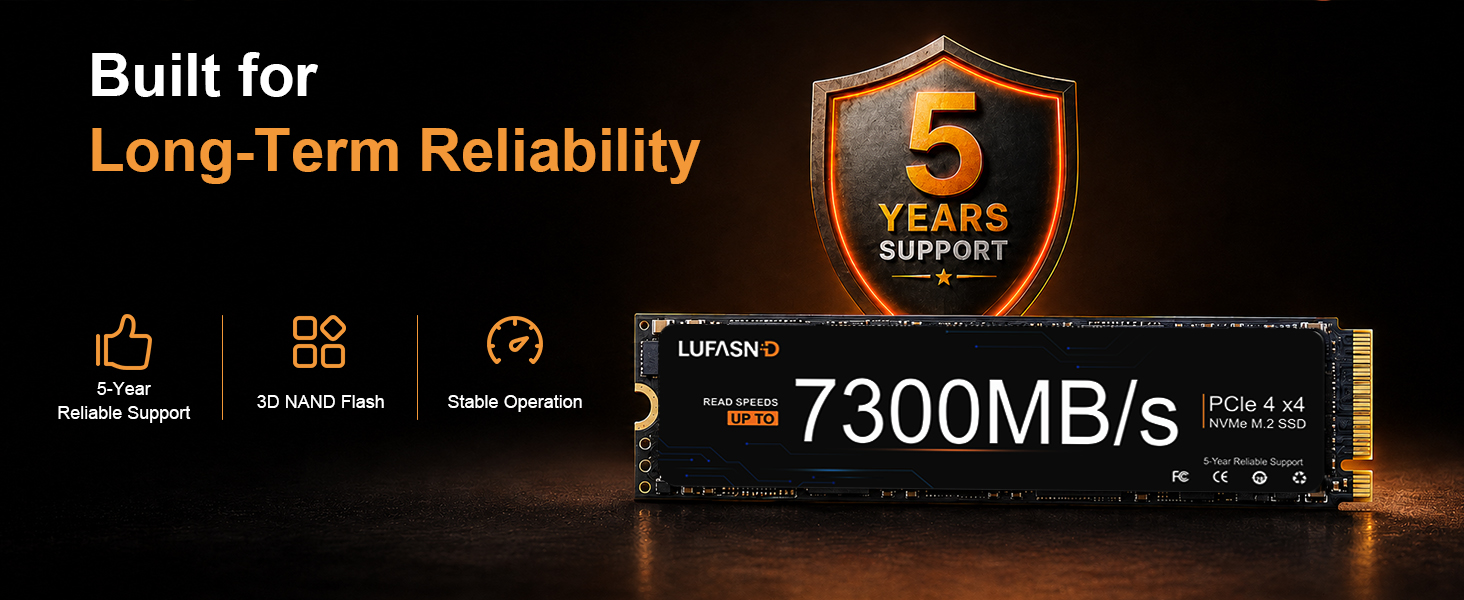
- Reliable 3D TLC NAND + 5-Year Warranty – Built with premium 3D TLC NAND Flash, the LUFASND SSD delivers stable performance, strong durability, and reliable data protection for gaming, work, and creative workloads. Backed by a 5-Year Limited Warranty, it provides long-term confidence and peace of mind for your storage upgrade.
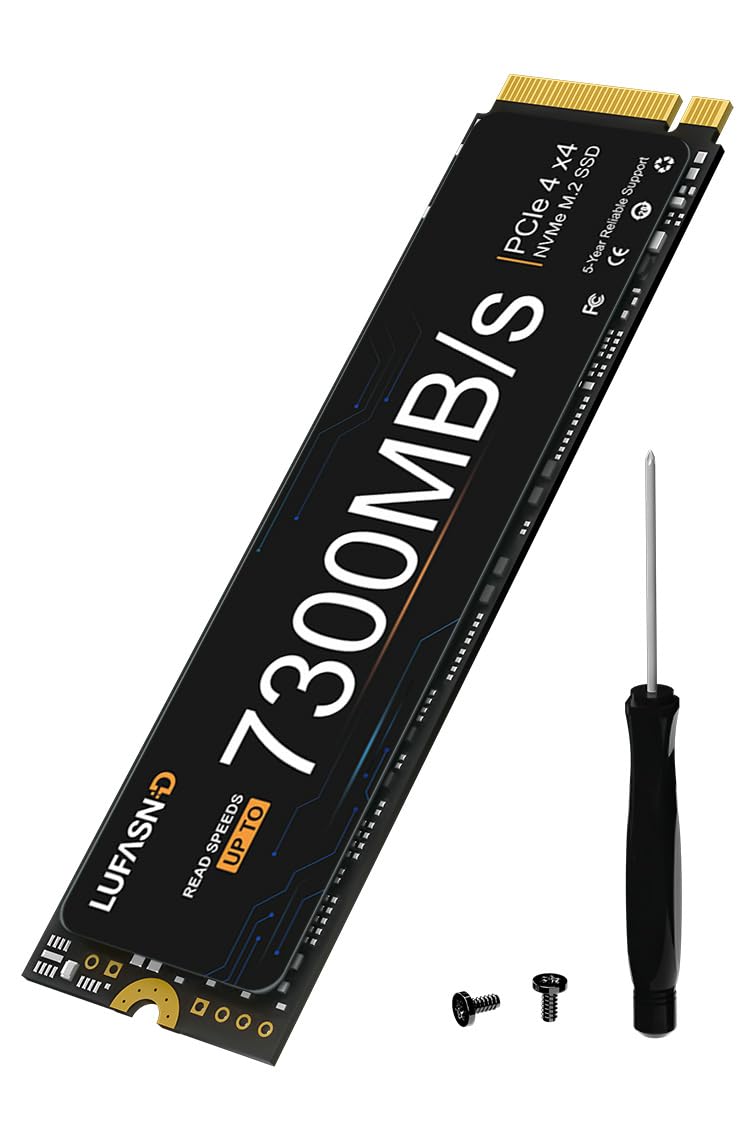
- Easy Installation with Included Tools – Standard M.2 2280 form factor ensures wide compatibility with PS5, desktops, laptops, and mini PCs. The package includes a precision screwdriver and mounting screw, allowing quick and hassle-free installation—even for first-time users. Package Includes: 1 × NVMe SSD 1 × Screwdriver 1 × Mounting Screw 1 × User Guide
- Massive Capacity for Gaming & Creativity – Available in 1TB, 2TB, and 4TB, this high-speed internal SSD provides ample storage for AAA games, 4K video editing, photos, creative projects, software, and large files. Whether you're gaming, creating, or upgrading your laptop, LUFASND delivers fast and reliable storage for everyday performance.
Is this SSD compatible with my device?
This SSD uses the standard M.2 2280 PCIe Gen4 x4 NVMe interface and is compatible with most desktops, laptops, and PS5 consoles that support PCIe Gen4 NVMe SSDs. Please verify your device specifications before purchase.
Can this SSD really reach up to 7300MB/s?
Yes. Up to 7300MB/s sequential read speed is achieved under ideal test conditions with a PCIe Gen4 x4 system. Actual performance may vary depending on your hardware, system configuration, and workload.
Is this SSD compatible with PlayStation 5?
Yes. This SSD meets the performance requirements for PS5 storage expansion. If you purchase the heatsink-free version, install a compatible heatsink before using it in your PS5.
Does this SSD overheat?
PCIe Gen4 SSDs generate heat during heavy workloads. This SSD is designed for stable performance, and proper airflow or a heatsink is recommended for optimal cooling during extended use.
Is this SSD reliable for long-term use?
Yes. Built with premium 3D TLC NAND Flash, this SSD delivers reliable performance for gaming, content creation, and everyday computing. Regular backups are recommended for important data.





| SKU: | B0H86GGV71 |
| Weight: | 7.94 g |
| Size: | 4 TB |
| Brand: | Lufasnd |
| Model: | NS-N03 |
| Colour: | Black |
| Manufacture: | Shenzhen Nandstor Technology Co., Ltd |
| Colour: | Black |
| Size: | 4 TB |
Product description
Is this SSD compatible with my device?
This SSD uses the standard M.2 2280 PCIe Gen4 x4 NVMe interface and is compatible with most desktops, laptops, and PS5 consoles that support PCIe Gen4 NVMe SSDs. Please verify your device specifications before purchase.
Can this SSD really reach up to 7300MB/s?
Yes. Up to 7300MB/s sequential read speed is achieved under ideal test conditions with a PCIe Gen4 x4 system. Actual performance may vary depending on your hardware, system configuration, and workload.
Is this SSD compatible with PlayStation 5?
Yes. This SSD meets the performance requirements for PS5 storage expansion. If you purchase the heatsink-free version, install a compatible heatsink before using it in your PS5.
Does this SSD overheat?
PCIe Gen4 SSDs generate heat during heavy workloads. This SSD is designed for stable performance, and proper airflow or a heatsink is recommended for optimal cooling during extended use.
Is this SSD reliable for long-term use?
Yes. Built with premium 3D TLC NAND Flash, this SSD delivers reliable performance for gaming, content creation, and everyday computing. Regular backups are recommended for important data.
I was somewhat cautious about this drive because LUFASND is not a brand I was familiar with, and Windows/CrystalDiskInfo identifies the SSD only as a generic “PCIe SSD.” After investigating the hardware and putting it through some testing, however, I have been pleasantly surprised.
I installed the 4TB NS-N03 in the CPU-connected PCIe 4.0 x4 M.2 slot of an ASRock Z790 Taichi running Windows 11. This is a workstation with a 13th-gen Intel CPU and two Radeon AI PRO R9700 GPUs, and I primarily intend to use the SSD for large AI/LLM model files, datasets, games, and other fast bulk storage.
Hardware investigation:
Although the SSD reports a generic model name, its PCI hardware ID is:
VEN_1DBE & DEV_5220
This identifies the controller as an InnoGrit IG5220 (RainierQX) PCIe 4.0 x4 NVMe controller. It is a modern DRAM-less design that uses Host Memory Buffer (HMB).
The drive itself is also single-sided, with all components on one side of the PCB. That is a nice feature for compatibility and cooling, especially in laptops or systems using motherboard M.2 heatsinks.
The PCB has the UL marking E186014, which traces to Brain Power (Qingyuan), while the included documentation identifies Shenzhen Haipusituo Technology as the company behind the LUFASND brand.
The Amazon listing specifies 3D TLC NAND, although I could not independently identify the NAND manufacturer from software diagnostics or the markings visible on the drive. So the TLC designation is based on the manufacturer’s product listing rather than direct identification of the NAND chips.
Performance:
The label advertises read speeds of up to 7300 MB/s.
In CrystalDiskMark using the standard 1GiB test, I measured approximately:
Sequential read: 6396 MB/s
Sequential write: 6115 MB/s
4K Q1 read: 90 MB/s
4K Q1 write: 292 MB/s
Those are already very good Gen4 numbers.
More importantly, I repeated the benchmark using a much larger 64GiB test size with 3 passes to make sure the drive was not only performing well with a tiny benchmark workload.
Results were still excellent:
Sequential read Q8: 6376 MB/s
Sequential write Q8: 5991 MB/s
Sequential read Q1: 3930 MB/s
Sequential write Q1: 5669 MB/s
4K Q1 read: 72 MB/s
4K Q1 write: 291 MB/s
The sequential performance barely changed between the 1GiB and 64GiB tests, which was encouraging.
For comparison, I also have a Samsung 980 PRO 2TB in this system. In my testing, the Samsung reached about 6790 MB/s read and 4940 MB/s write. The LUFASND was slightly slower in peak sequential reads but considerably faster in these short-to-medium sequential write tests.
That does not necessarily mean it will sustain 6GB/s writes indefinitely. A nearly empty 4TB SSD can have a very large pseudo-SLC cache, and I did not intentionally write hundreds of gigabytes continuously just to exhaust it. But for normal desktop use, gaming, and especially large read-heavy AI model storage, the observed performance is excellent.
Thermals and SMART health:
Cooling has also been very good.
The drive normally sits around 38–40C and reached only about 48C after the 64GiB 3 benchmark under the ASRock motherboard’s M.2 heatsink.
CrystalDiskInfo showed:
0 critical warnings
0 media/data integrity errors
0 warning-temperature time
0 critical-temperature time
0 thermal-management/throttling events
The benchmark generated several hundred gigabytes of additional reads and writes, and the SMART health remained at 99% afterward.
My system already has two blower-style workstation GPUs installed, so these temperatures were measured in the actual completed workstation rather than on an open test bench.
What I like:
The biggest surprise is that this is not simply a slow generic SSD hiding behind optimistic marketing numbers. It uses a legitimate high-performance InnoGrit Gen4 controller and delivered roughly 6.4GB/s reads and 6GB/s writes in my system.
The 4TB capacity, single-sided PCB, good temperatures, and strong large-file performance make it particularly attractive for things like AI models, game libraries, large datasets, and other read-heavy storage.
What remains unknown:
The main unanswered question is long-term reliability. This is still a relatively obscure brand, the drive presents itself generically to Windows, and while the listing specifies 3D TLC NAND, I could not independently identify the actual NAND manufacturer.
I would therefore still keep proper backups of anything important—which is good practice regardless of SSD brand.
Bottom line:
So far, this drive has exceeded my expectations. The controller is an InnoGrit IG5220, the hardware is single-sided, temperatures are excellent, SMART data is clean, and performance remained strong even with a 64GiB 3 benchmark.
If long-term reliability holds up, this appears to be a very capable 4TB PCIe 4.0 NVMe SSD. For my intended use as a large AI-model and high-speed storage drive, I am very satisfied with it so far.
I ordered this drive to use in one of those small factor PCs out there. I needed additional space for data, and this drive looked like it could help. The drive comes in a plastic bubble in a cardboard box and is bundled with a screwdriver and two retainer screws. Installation was easy; just install it like any other NVMe drive, and because the drive is blank and uninitialized, it can be used in pretty much any PC.
I installed this drive in a Windows 11 PC, initialized it, and formatted it without any issues. As soon as that was done, the drive showed up and was ready for use. While the speeds of this drive are half of what you’d get with a Western Digital Black drive of the same type, the price point is worth that reduction. In reality, it still beats the old spinning drives.
I did a thorough speed test on this SSD connected to a USB PCIe 3.0 x2 controller and these are the results
Random Read: 223.34 MB/s
Random Write: 207.61 MB/s
Sequential Read: 883.94 MB/s
Sequential Write: 634.38 MB/s
The sequential read test is bottlenecked by my USB connection, so that tells me it’s much higher. I’m not sure why the others are lower though. My USB card is RTL9210B-CG PCIe Gen3 x2, so this only has half the bandwidth at a lower PCIe standard, but in that case all the reads/writes should’ve been at around the same speed. 7.3GB/s is insane so I’m not sure if it’s a typo or I just need to put this in the proper slot. I plan on putting this in my router/server but it’s going to be an ordeal. Regardless, this thing is fast and is the advertised size.