The War Game
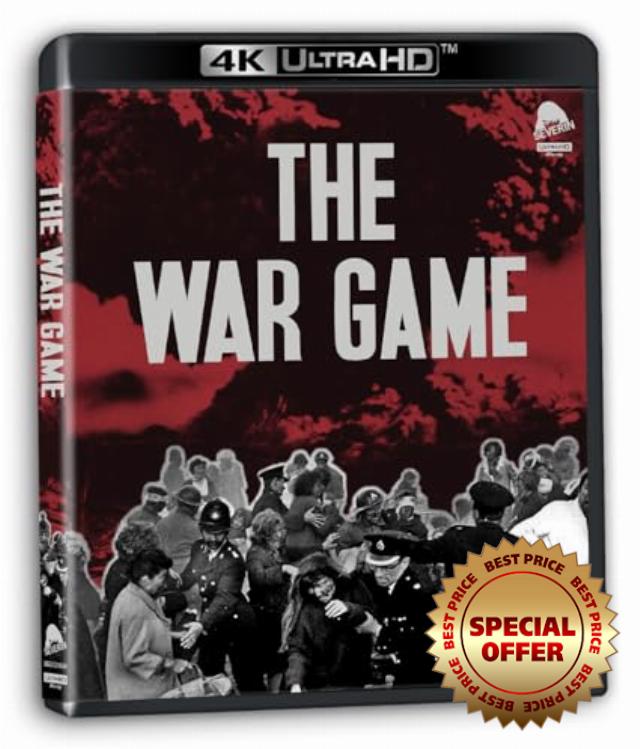
The War Game
Peter Peter Watkins’ BBC docudrama depicts a nuclear attack on Great Britain. For three decades it was considered “too horrifying” to be broadcast.
THE WORLDWIDE UHD PREMIERE
TWO-DISC COLLECTION WITH 5+ HOURS OF SPECIAL FEATURES
In 1965, filmmaker Peter Watkins (PRIVILEGE, PUNISHMENT PARK) recruited 350 amateur actors, utilized direct quotes from civil defense manuals and employed newsreel-like recreations to craft a BBC documentary drama that depicted a nuclear attack on Great Britain. The network condemned the finished film as “too horrifying” and refused to broadcast it. Watkins’ masterpiece subsequently received a special award at the 1966 Venice Film Festival and won the 1967 Academy Award® for Best Documentary Feature. The BBC would not air his “chillingly different, enduringly brilliant” (The Guardian) classic until three decades later. “What may be the most important film ever made” (The Observer) is now scanned in 4K from the original 16mm A/B rolls for the first time ever, with more than 5½ of all-new Special Features.
Special Features
- Introduction By Filmmaker Alex Cox
- Commentary By Film Critic Kim Newman And Filmmaker Sean Hogan
- Interview With Anne Davey Orr, Production Designer On CULLODEN And THE WAR GAME
- Interview With Peter Watkins Historian John Cook
- Video Essay By Dr. Alexandra Heller-Nicholas And Filmmaker Stephen Broomer
- THE WAR GAME At Cine City – Featurette By Journalist Eric Veillette
- Interview With Julie McDowall, Author Of Attack Warning Red! How Britain Prepared For Nuclear War
- Archival Interview With Editor Michael Bradsell
- Peter Watkins Reflects On THE WAR GAME And The Media
- Introduction To THE WAR GAME In Sheffield By Visions Producer John Ellis
- THE WAR GAME In Sheffield – Peter Watkins Recruits For A Proposed WAR GAME Remake In Unused Footage For The UK TV Show Visions
- Trailer
- Peter Watkins Short Films THE DIARY OF AN UNKNOWN SOLDIER And THE FORGOTTEN FACES
- Reprint Of Government-Issued Evacuation Card
Bonus Materials
- Audio Commentary With Film Critic Kim Newman And Filmmaker Sean Hogan
- Introduction By Filmmaker Alex Cox
- Conflict By Design – Interview With Anne Davey Orr, Production Designer On CULLODEN And THE WAR GAME
- Who Banned THE WAR GAME? – An Interview With Peter Watkins Historian John Cook
- Games Of Fact And Fiction – Video Essay By Dr. Alexandra Heller-Nicholas And Filmmaker Stephen Broomer
- THE WAR GAME At Cine City – Featurette By Journalist Eric Veillette
- Nuclear Britain – Interview With Julie McDowall, Author Of Attack Warning Red! How Britain Prepared For Nuclear War
- Archival Interview With Editor Michael Bradsell
- Peter Watkins Reflects On THE WAR GAME And The Media – 1983 Interview From The Australian Film Television And Radio School (AFTRS)
- Introduction To THE WAR GAME In Sheffield By Visions Producer John Ellis
- THE WAR GAME In Sheffield – Peter Watkins Recruits For A Proposed WAR GAME Remake In Unused Footage For The UK TV Show Visions
- Trailer
- THE DIARY OF AN UNKNOWN SOLDIER – Short Film By Peter Watkins
- THE FORGOTTEN FACES – Short Film By Peter Watkins
- Reprint Of Government-Issued Evacuation Card
Cast & Crew
Actors:- Dick Graham
- Michael Aspel
- Dave Baldwin
- Kathy Staff
- Peter Watkins
Director: Peter Watkins
Producer: Peter Watkins
| SKU: | B0H12YP52H |
Als hätte jemand eine Videokamera mitgenommen...
Ich stand letztes Jahr bei kaltem Wind und Regen auf “Cil Lodair Muir”, dem historischen Schlachtfeld in der Nhe von Inverness und kann sagen: Der Film reicht nicht ganz an die Realitt ran, aber auch nur, weil man im Film den Wind nicht sprt! Mit Untersttzung der rtlichen Bevlkerung wird (im Reenactment-Style und in Schwarz-Wei gedreht) ein beklemmendes Bild der letzten Schlacht auf britischem Boden geboten. Die Macher schildern an verschiedenen Beispielen das Schicksal eines einfachen britischen Infanteristen, die Clanstruktur vom “Chief” ganz oben bis zum Knecht ganz unten und wofr die Mnner am 16. April 1746 auf dem Hochmoor standen, das fr viele nicht mehr verlieen (sie wurden dort begraben). Auch die bis heute sprbaren Folgen der nicht mal eine Stunde dauernden Schlacht werden thematisiert. Alles in Allem ein Stck gut recherchierte Geschichte ber einen Konflikt, der nicht vielen bekannt ist, aber weitreichende Folgen hat. Einen Stern Abzug fr das Fehlen der deutschen Synchronisation (der Film lief schon mal mit dtsch. Synchro im Fernsehen).
Same as it ever was
Harrowing accounts of the aftermath of nuclear war and of the butchery of British forces against the Scots. Both pertinent warnings from history. While politicians lie – you can always tell – watch their mouths: their lips move – the ordinary populace has to pick up the pieces of the detritus left by the elite and their decisions.
The government banned The War game by pressure on the BBC – the English broadcast and general propaganda mouthpiece for those unfortunate to receive it. Now Putin’s bombs are targetted on the Clyde, an outpost of the North British, a short distance from the largest population, not of London, of course – do you want a riot on the streets? but of the meek, submissive North British, weaken by centuries of political brow-beating and lip service from remote Governments.
Which brings us to one of the most shameful episodes in butchery in British history. As a portent of their submission of entire swathes of the globe, the British used the rising of Prince Charlie, not too Bonniely portrayed in the drama-documentary “Culloden”, directed also by Peter Watkins, to suppress the culture, language and means of livelihood and even existence of the Scots. The actions, comparable only to those of Nazi Germany, still live on in family memories and folk tales. This film is based on the account of the battle and subsequent massacres by John Prebble.
While the divisions in the society of the North Britons are most obvious to those who live there, the foundations of greed and need are easy to see in the Scots who take the King’s shilling and butcher their own – an earlier version of the “We wus only obeyin’ orders, man, ye ken” and those forced to sacrifice themselves under fear of eviction and slaughter by their landed kinsmen and overlords.
These films do not show human nature at its best and leave much to contemplate. Nowadays, with the fogs of war still shrouding Ukraine and the political and economic wasteland of those who chose to be North British over self-determination and hope, British and North British can ask themselves if human nature has changed much since the Romans asked themselves if these islands are really worth the sacrifice for a wee bit of salt.
Two Powerful Docudramas That Remain Relevant Today
These two films by Peter Watkins were far ahead of their time. War Game is a point of view presentation, often with a hand held camera, that gives a feel of urgency and reality to the situation. The film is a frightningly graphic representation of the implications of a nuclear war in 1960’s Britain. The implications are obvious, the immediacy and total destruction caused by nuclear war would be the same everywhere. Many frank admissions are revealed, based on actual UK government papers and give no solace or comfort to anyone watching the film. The film is a brutal presentation of modern war, where everyone is a target, and the front lines are in your own home and streets.
The second film is Culloden. It is about the final battle of the last of the Jacobite Rebellions. Presented in the same style as the War Game, the film is a first person perspective of warfare in the mid 18th century. The humanity and inhumanity come across with brief vignettes of the people caught up in these events. The waste and injustice of war are unsparingly presented with an honesty that infuriate and depress.
Both of these films suffered from censorship at the time of their release. The War Game was deemed too horrifing by the UK government, and Culloden was banned in several Commonwealth counties, presumably as it would stir up anti British and pro independence sentiment. These are both unusual and powerful films with a truth and impact as relevant today as when they were made.
Culloden : un chef d'oeuvre télévisuel
J’ai achet ce DVD pour le documentaire de Peter Watkins sur la bataille de Culloden et j’ai dcouvert un chef-d’uvre de la tlvision. Ce documentaire en noir et blanc prsente la reconstitution de la bataille de Culloden, la dernire bataille qui eut lieu sur le sol britannique, comme si des camras de TV taient prsentes. Les cossais des Highland furent opposs l’arme anglaise et les consquences de leur dfaite furent catastrophiques. Les combattants furent massacrs. Pendant de longues annes, les anglais interdirent en vrac : la langue galique, le port du kilt, la cornemuse et bien d’autres choses. Le documentaire de Peter Watkins, en utilisant le style reportage avec camra l’paule et des acteurs non professionnels provoque l’motion du tlspectateur et dresse un rquisitoire contre le colonialisme en gnral et la guerre et ses consquences. Ses prises de position radicales, comme dans l’autre documentaire sur la bombe atomique ont condamn cet excellent ralisateur une audience quasi confidentielle. Dcouvrez-le avec ces deux documentaires en anglais, galique et accent cossais garanti, sous-titrs en franais.
Why it has taken all this time for these two films to make it to the US in DVD form is a story that I hope comes out. Peter Watkins is finally being ackowledged in the US for his radical, truly independent vision, what with the release in the last two years of Punishment Park and The Gladiators. But it is here, in his first two feature films, that he is arguably at his best. The War Game is a horrifying recreation, done in documentary style, of what the effects of nuclear war would be. It may not have the impact it had when it was first released in 1964 as the US and the Soviet Union had their fingers on the button that would have assured, as the film so disturbingly shows (so disturbingly that the BBC, who commissioned the film, refused to show it and it was effectively banned in England for years after), mutual destruction. Nonetheless, the threat of nuclear warfare has not totally disappeared from the radar screen, so the film still carries relevance. Culloden, which predates The War Game, is perhaps the more contemporary and frightening film. Here, Watkins introduces for the first time in a feature length piece his “you-are-there” technique, as participants in the Scottish uprising against Britain in the mid-eighteenth century are interviewed as though news and camera men existed at this time. Both films reek with realism, as they are acted by non-professionals; and in the case of Culloden, the grime and sweat of eighteenth century life and the ferocity and brutality of combat at this time comes across as though, indeed, cameras were available at this time. Watkins is clearly aghast at what people can do to each other, and Culloden, culminating with the massacre of the Scottish clans by the better armed and more ruthless British military, clearly, as Watkins himself as said, is another way of looking at what was occuring and would continue to occur in Vietnam. Today, with another war, the film retains its power and relevancy. These are not easy films to watch: they are no doubt one sided and pedantic: yet they speak to a time when filmmakers were willing to alienate and confound in order to make what they felt was a difference: a time when the idea of popular film instigating change, naive as it may be, felt possible.
Glad to find this film!!
The dvd was as described. It is in very good condition and played readily on my dvd player. It is a rare find, and I was very happy to be able to get it on dvd!!
The Wargame, made in the mid-1960s, dealt with the prospect of a major nuclear strike on the UK. In its depiction of the effects and consequences of using these weapons it quite rightly pulls no punches. However, I would take issue with premise that it was all OUR fault. The Russians were lobbing their nukes at us because we had the temerity to arm ourselvs with our own deterrent, ie the V-Force of Vulcan, Victor and Valiant bombers, thus, so the argument went, making us a target.Just why the Russians would resort to such apocalyptic measures knowing the response would be their own inevitable destruction was never explored. I think the film was very well made, believable in its depiction of the transition to war and then the effects of that war, but at the same time I felt it was rather biased in the usual left-wing “blame the west” manner, ala CND. I think the other nuclear horror story “Threads” was more balanced in its presentation, and all the MORE terrifying for it.
“The War Game” is a surprisingly effective documentary, especially for the time that it was released. I felt that it was actually more haunting than “Threads”, due to its colder atmosphere of hard facts and ebony and ivory images of charred bodies and demolished edifices. I often found “Threads” to actually be somewhat of a disappointment, especially with the initial attack scenes and cinematography that REALLY looks dated–especially for a movie that was made in–1984?!?! (Looking more like it was made in the early 70’s in many spots). “The War Game”, I felt, did a better job at hitting you with both fists–especially without any element of a “standard British kitchen sink drama” that “Threads” contained. Don’t get me wrong, I still feel “Threads” is a good film, but one that could have been better, especially in light of how brutally honest “The War Game” was with its theme. Overall, I will always feel that when it comes to nuke films, “The Day After”, does it best, due to its extremely chilling atmosphere and convincing performances. Also, contrary to what people have said, “The Day After” is NOT a soap opera with nukes, nor is it “Mister Roger’s Neighborhood” as some reviewers of “Threads” have mentioned, but a HIGHLY effective thriller and a bona fide wake-up call. In conclusion, for me “The Day After” is the best, but second in line is “The War Game” with its bona fide chilling effectiveness. Definitely worth a viewing.
The War Game is one of the best films about Nuclear War.I first saw a snippet of this on the documentary Cold War and own the VHS copy. In general, these types of stories typically have 3 basic parts: pre-attack, the attack and post attack. Of the movies made in this genre, The War Game is the strongest in dramatizing all 3 parts. What helps the War Game along is that we do not get attached to any one character (my version is only 50 minutes long) like you do in the rest of the movies in this genre. When you attempt to follow the fate of one character or a group of people, you can lose the larger societal implications of nuclear war effects.
Some contrasts: First, there are 2 other major movies that are part of this genre called Threads and The Day After. Threads was a British movie. The Day After was its American counterpart. Both are decent stories but I would give Threads some advantage here.
1) Threads does the best job with showing pre-attack and attack conditions starting from the basic bliss of most people to the terrifying attack.
2) The movie the Day After shows a good deal of the pre-attack and post attack conditions but it gets carried away with the attack situation. Its characters are very shallow and detract from an otherwise well-told story.
One of The War Game’s flaws is its obvious scoffs at religion. Many of the quotes seem to suggest that American ministers are backward and stupid for making suggestions like not giving shelter space to the passing stranger. What a modern viewer may not understand is how close the US and the USSR came to nuclear annihilation during this time frame and how practical this advice really was.
The War Game’s other obvious flaw is its creating moral relativism with the Soviets. The movie portrays the fact that the US and its NATO allies may have been the first to use nuclear weapons in a battle over the Fulda Gap in Germany (a likely hotspot). What the story does not explain is how the Soviets had such a large and menacing conventional presence in Eastern Europe (and the Western Europe’s inability or lack of desire to take on its own defense) caused this to become part of our policy. The War Game also fails to explain how the Soviet sub fleet went from being a coastal defence force to an offensive force in rapid order with reactors and weapon systems extremely prone to accident (as evidenced by the greater number of subs lost in the Soviet fleet than in the American fleet). These factors did a great deal to de-stabilize Western Europe for some time.
The War Game is a harrowing and disturbing account of the aftermath of a nuclear hydrogen bomb attack on Kent, UK. It gives the lie to the British Government propaganda of the day, mid 1960’s, that one could survive a nuclear war. Whilst it is a work of fiction, it uses actual and well documented events that happened in WWII, from the 1000 bomber raids over Germany which led to fire storms, the most infamous of which was Dresden, to the aftermath of the two atomic bombs dropped on Nagasaki and Hiroshima.
This is not an easy film to watch, and is certainly not for the squeamish. It is only around 45 minutes long, but into this it packs a massive punch. The British Government of the day thought the British public should not see it, and it was banned from being screened for 20 years until 1985, such was the power of its message.
This is probably the most thought provoking film on a war that, fortunately, has not happened and one must sincerely hope it never does.
The War Game is paired with Culloden, dealing with a specific period in Anglo-Scottish history and is, therefore, limited in its audience appeal. This is another triumph in the documentary style of Watkins and deals with the subject from the perspectives of those who fought in the battle from the lowliest to the highest in rank.
There are two prints of this release. One by the British Film Institute, and the other on a Region 1 DVD from the US. I went for the US release as the print is marginally cleaner. The DVD has superb liner notes looking into the history and making of The War Game with many insights into the machinations of Government, Churchill’s involvement, and the climb down by the BBC, all of which led to the delay in the film being shown to the public. Given this, and the pressures on Watkins, it is a marvel itself that the film was ever completed.
If you have the stomach for it, this is a must see film. And it is most certainly likely to change your view on a nuclear war being “winnable”.