Pure Sine Wave Inverter 2000 watt Inverter DC 12V to AC
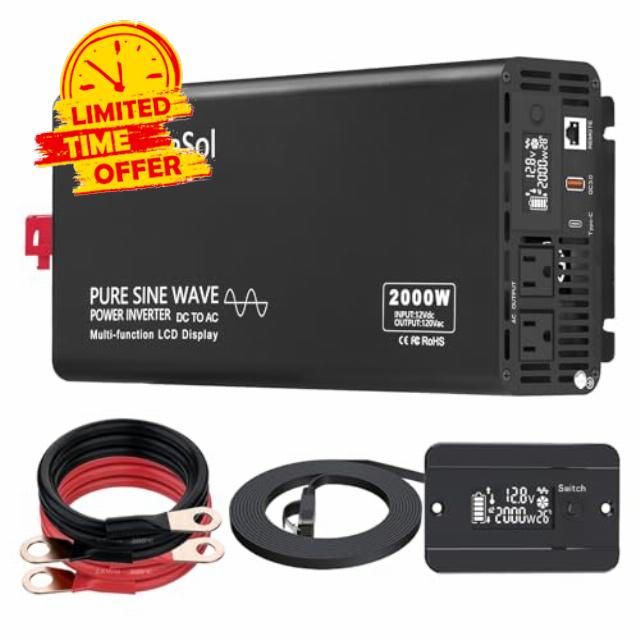
Pure Sine Wave Inverter 2000 watt Inverter DC 12V to AC 110-120V, Power Inverter for RV Truck Home Backup Solar with 2 AC Output, USB&Type-C, LCD Remote Monitor, Surge 4000W
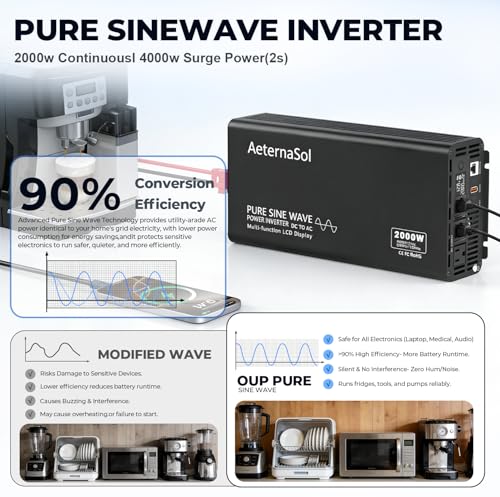
- 【FCC-approved True 2000W Pure Sine Wave Inverter, Better Protect Your Device】The rv power inverter can provide 2000W continuous clean DC to AC power (4000W surge) with max efficiency >93% , which strongly reduces conversion loss and protect sensitive electronics (Microwave Oven, Laptops, CPAPs, LEDs) from damage. Handles heavy startups (Coffee Machine, Window AC, Power Tools) effortlessly.
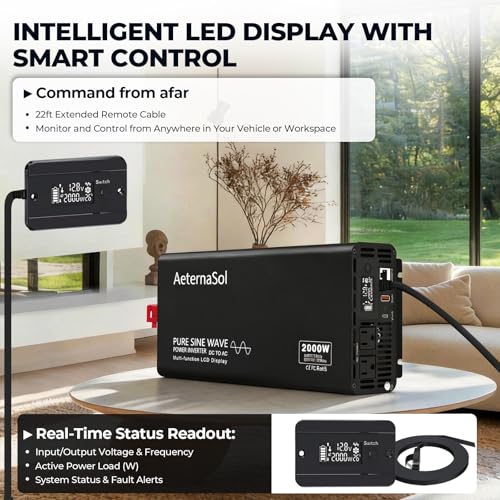
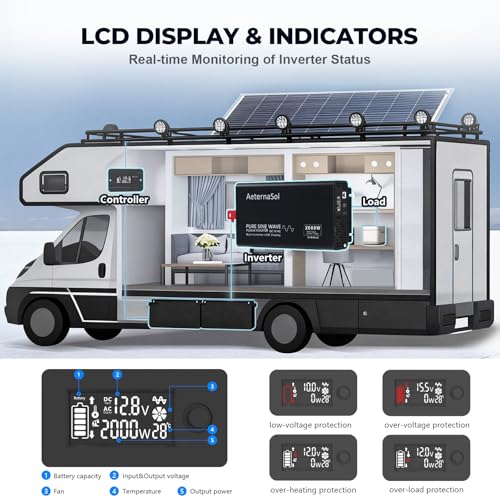
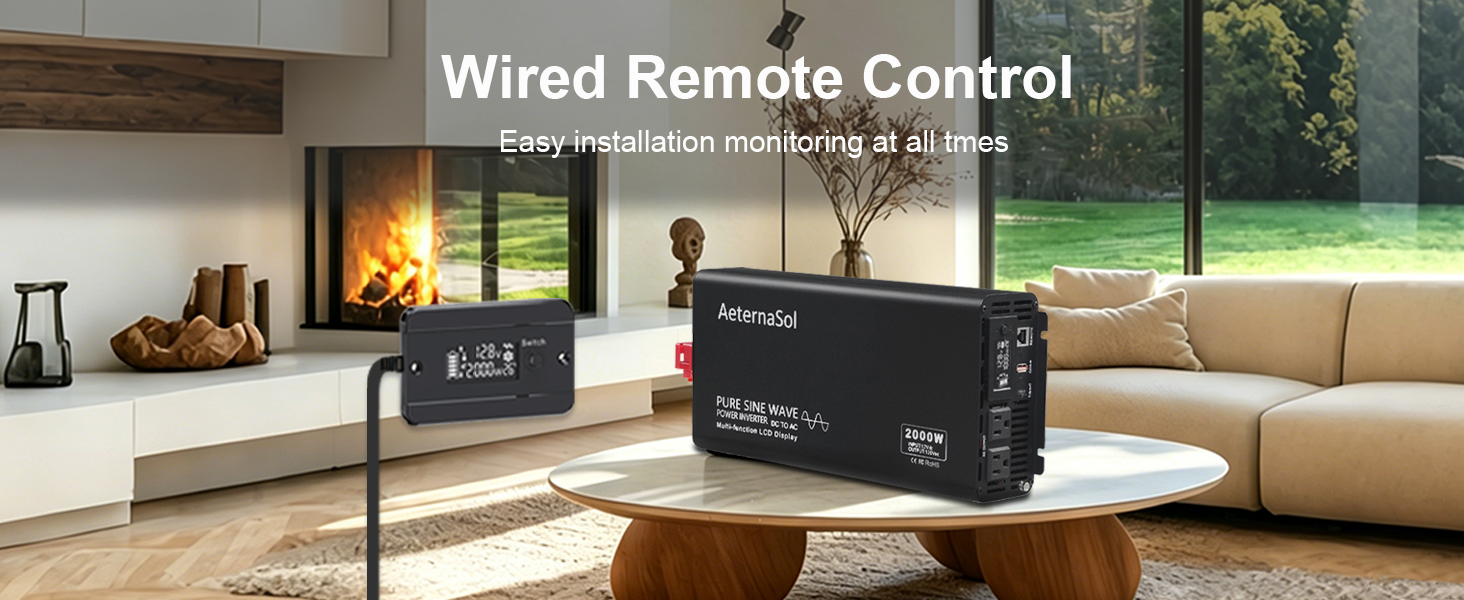
- 【Remote Control with LCD Screen Display】2000 watt inverter for home comes with 14.76ft wired remote controller. Its smart LCD screen could track battery levels, output or errors in real time. Allows you to easily identify the current status and alert messages. One-touch shutdown/restart design is ideal for trucks, RVs and job sites.
- 【Multiple Safety Protection】The power inverter for truck is designed with undervoltage, overvoltage, overload, overheating, short circuit and Isolated Input & Output protection. The rugged and heat-dissipating full metal shell can greatly ensure the long-term use. It can withstand site falls, RV vibrations and emergency surges, which can effectively protect the inverter.
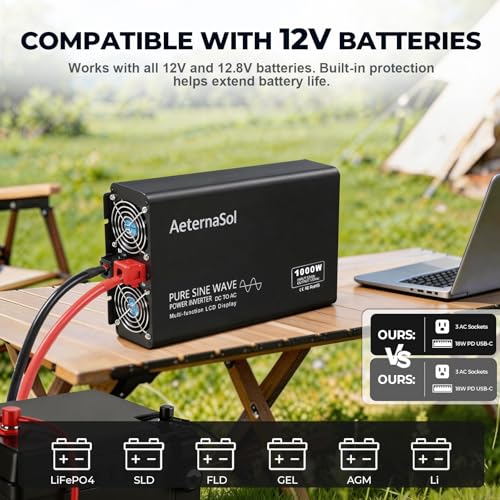
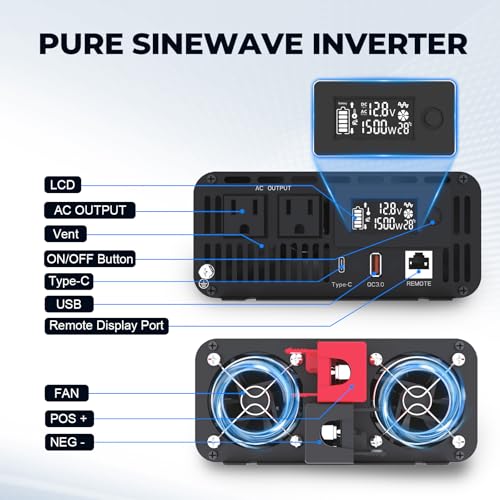
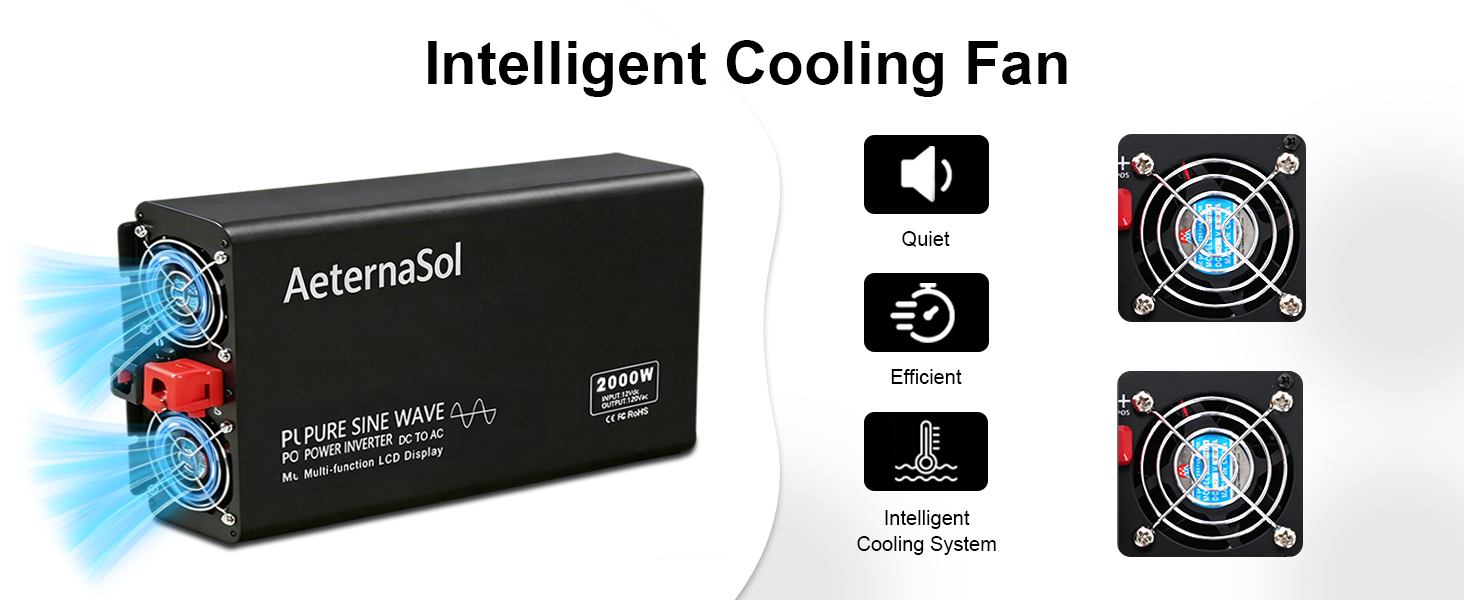
- 【Intelligent Temperature-Controlled Cooling Fan】This inverter with remote comes with intelligent temperature-controlled silent fan. When temperature exceeds 45℃, the fan will automatically start, and stop when it falls below. Aluminum alloy body shell also is designed for better heat dissipation.
- 【2 AC outlets & Fast Charging USB/USB-C Meet All Your Needs】The power inverter for vehicles 2000W comes with 2 AC outlets, 1 USB (max 18W) and 1 Type-C (max 22W), which support fast charging of multi-device at the same time.
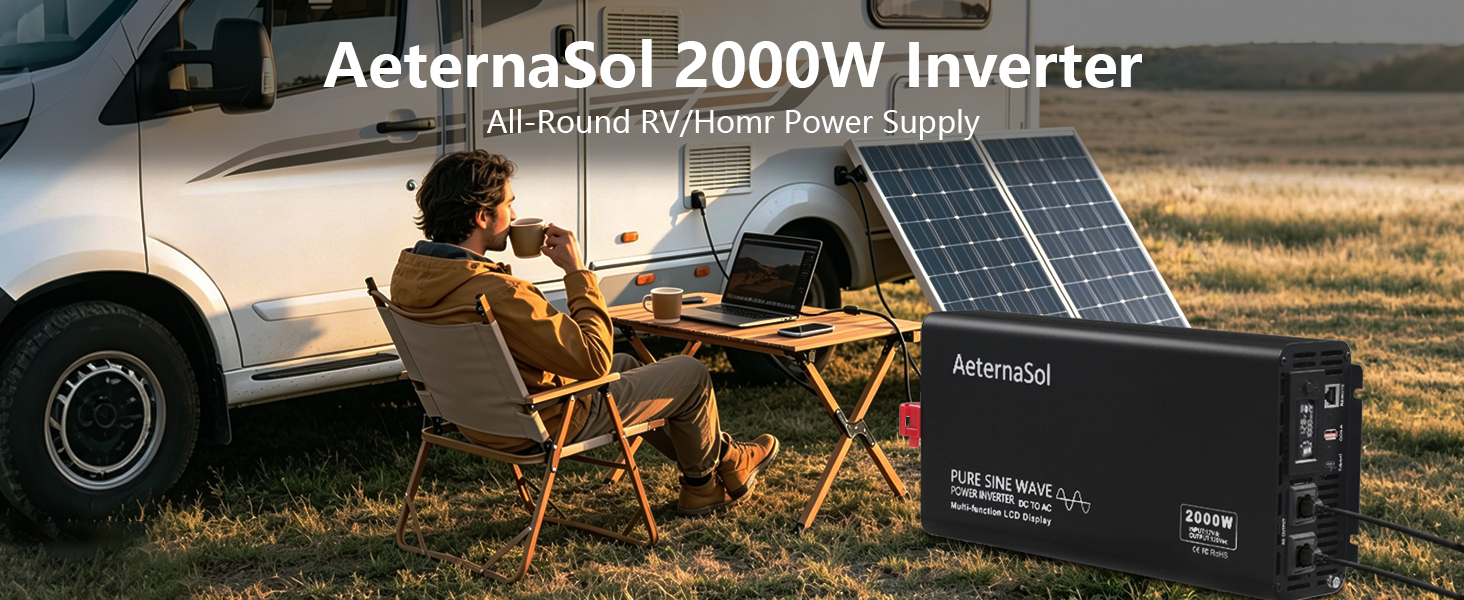
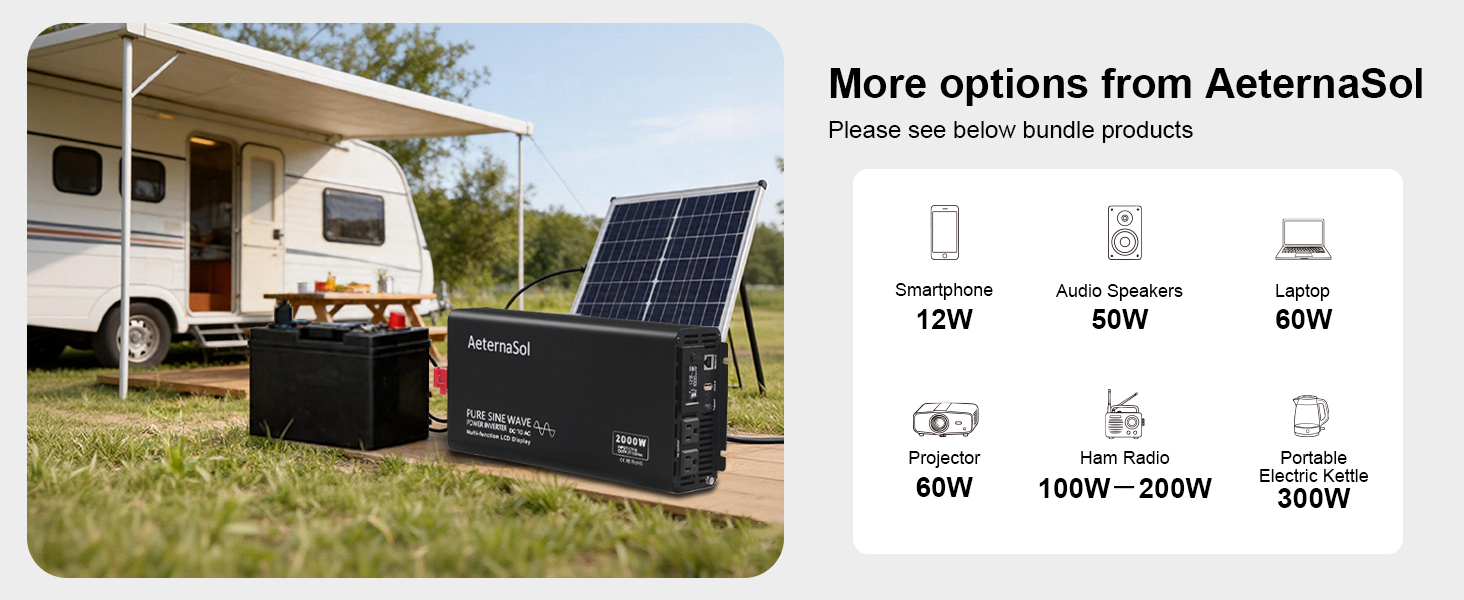
- 【Wide Use】12v power inverter is deal for campers/truckers, outdoor camping, travel, road trip, work van, class B van, trailer, pickup truck, F-150 bed, EV, electric vehicle, indoor home backup for emergency, power outages, solar shed, off grid storage shed, shed, class B van and so on. Great for charging string lights, CPAP machine, camera, nebulizer, game console, kindle, TV, DVD players, lights, iPhones, iPad, car vacuum cleaner, LED table lamp, mini fridge and other electronic devices.
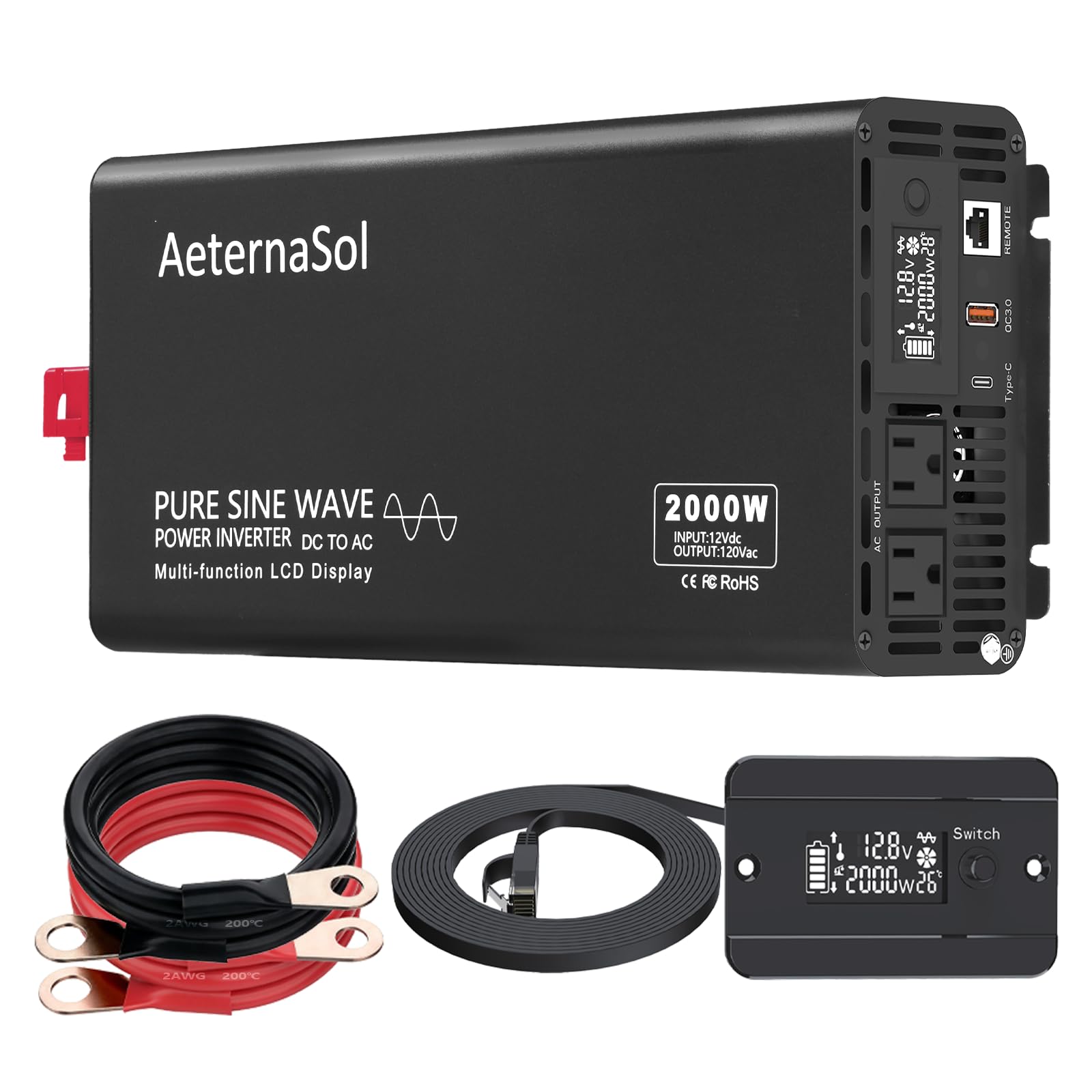
- 【2-Year Warranty】Package includes 1x Pure Sine Wave Inverter, 1x User Manual, 2x Battery Cables, 1x 14.76ft UTP flat patch cable, 1x Wired remote controller and some fuses. 24/7 customer service. For any questions, pls feel free to contact us.

| SKU: | B0GC3YQBZF |
| Weight: | 8.9 Pounds |
| Dimensions: | 11.8"L x 9.1"W x 3.9"H |
| Brand: | AeternaSol |
| Model: | AEYL-15 |
| Manufacture: | AeternaSol |
Product description
3 months use and I’ve bought anothe
After using this 24/7 for 90 days straight I decided it was by far the best pure sine wave inverter in this price range and for my purposes. The installation was very easy but I also had everything setup beforehand and just basically needed to plus in the inverter. The power output is above what I am accustomed to from my 3-5 year old inverters which was and still is a great attribute. During the past 90 days I’ve watched my battery’s life slowly increase and then plateau meaning this inverter “healed” my batteries within about 3 weeks. I was not expecting that but surely am grateful for it. Also during its use it has not once become too warm or emitted strange electrical smells as some of my older solar equipment tent D’s to do. I’ve come to appreciate this for its simple installation, it’s ability to increase the overall battery life and finally it’s shown to be as reliable as I could have ever hoped for in this price range. I have this connected to 1400watts in solar panels from this company AeternalSol some of which I received thru Vine and the others I bought after witnessing their performance. This inverter and everything coming into and going out of this inverter is from this company so I do not know how compatible it is with other brands but I do know it works very well in my setup as is and I would recommend it.
Nice unit, hacker-friendly desig
Review will focus on remote management, as I’m interested mostly in automation and dashboards, not pushing the 2000W inverter to test its limits to power something like a whole RV, though I should note the wired remote control/display module is quite nice for a setup like an RV where the inverter sits in a utility cabinet, or for something like a solar cart.
Opening the housing for the remote control/display (which is, thankfully, straightforward), I note substantial flux residue left behind; *probably* not a big deal, but I furrow my brow at it anyway. I didn’t try the debug pins except to use the easy-access ground.
A quick note here that following the proceeding instructions almost certainly voids whatever warranty Aeternalsol offers; I’m not recommending you do this; I’m just trying to relay this unit is hacker-friendly if you should be so inclined.
You can connect to pin 1 (where the divot is) on the SP485EE chip to get readout data, which I sent to a Xiao ESP32C6 (pin D7); this gives us the data going to the LCD screen (maybe there’s a better way, but this struck me as reasonably straightforward). The ESP32C6 is small enough to fit inside the enclosure, and you could power it over remote display board rails if you like; this would permit a pretty easy mod to give you the data over WiFi/BT/whatever-you-like, hidden inside the remote display enclosure; an ESP32C6 (and C3) is more than capable of running a basic web server. Note you cannot switch the panel on/off this way, as that must use the physical button (wellllll… it doesn’t “must”, but I’m not going to cover bypassing it).
Here’s the Micropython script as I presently have it (the lookup table is only accurate-ish up to 107W; you must measure what LCD outputs and compare to raw byte outputs to update higher values in LUT beyond that):
from machine import UART, Pin
import time
import struct
# High rxbuf ensures we catch every spike
uart = UART(1, baudrate=19200, tx=16, rx=17, timeout=10, rxbuf=1024)
print(“Inverter sniff script start.”)
HEADER = b’xFCxFCxFCxFCx37′
PACKET_LENGTH = 15
buffer = bytearray()
# — HARDWARE CALIBRATION CURVE (LUT) —
# Format: (Raw_ADC_Value, LCD_Displayed_Watts)
# For useful readings above 107W, you must compare what the LCD displays to what script outputs, then add the (RAW[8:9]_Decimal, LCD_Watts) to table.
# Byte outputs are little-endian, so you must take byte 9 first, then byte 8 after, then convert that hexadecimal value to decimal (e.g. if byte 8 reads 3B, and byte 9 reads 00; you need to reverse the order to get 003B, which converts to 59 in decimal).
# Because the LCD updates when it wants to and we update when we want to, you want to use data for the LUT only when power output levels off somewhere. Dunno where you get a 2KW adjustable AC load, but that’d be ideal.
# Ensure they stay in ascending order (smallest RAW to largest RAW).
POWER_CURVE = [
(0, 0),
(15, 7),
(59, 13),
(71, 19),
(116, 26),
(191, 47),
(768, 63),
(828, 80),
(952, 107),
(2000, 225) # Fake/extrapolated datapoint
]
def interpolate_power(adc_val):
# Find which segment of the curve the raw value falls into
for i in range(len(POWER_CURVE) – 1):
x0, y0 = POWER_CURVE[i]
x1, y1 = POWER_CURVE[i+1]
if x0 <= adc_val <= x1: # Linear interpolation formula return y0 + (y1 - y0) * ((adc_val - x0) / (x1 - x0)) # If the load is higher than our table has real data, make a guess with last known slope x0, y0 = POWER_CURVE[-2] x1, y1 = POWER_CURVE[-1] slope = (y1 - y0) / (x1 - x0) return y1 + slope * (adc_val - x1) def parse_inverter_packet(pkt): if len(pkt) < PACKET_LENGTH: return # --- 1. BATTERY VOLTAGE & BARS --- batt_v_sag = struct.unpack('b', bytes([pkt[10]]))[0] batt_volts = 12.80 + ((batt_v_sag + 1) * 0.04615) bars = 1 if batt_volts >= 13.0: bars = 5
elif batt_volts >= 12.5: bars = 4
elif batt_volts >= 12.0: bars = 3
elif batt_volts >= 11.5: bars = 2
# — 2. AC POWER (W) —
real_power_adc = pkt[8] + (pkt[9] << 8) ac_watts = interpolate_power(real_power_adc) # --- 3. AC VOLTAGE & STATUS --- ac_volts_raw = pkt[11] status_flag = pkt[12] # My assumptions here are likely wrong; I exclude the data from print lcd_ac_volts = 121 if (110 <= ac_volts_raw <= 130) else ac_volts_raw # Create Raw Hex string for debug & LUT additions raw_hex = " ".join(f"{b:02X}" for b in pkt) # Print formatted output matched to LCD print("="*50) print(f"RAW : {raw_hex}") print(f"BATT : {batt_volts:.2f} V [{'#' * bars}{'-' * (5-bars)}] ({bars}/5 Bars)") print(f"OUTPUT : {ac_watts:5.1f} W") # likely incorrect | print(f"AC OUT : {lcd_ac_volts} V (Real Internal: {ac_volts_raw}V)") # no idea what the codes are supposed to be or if I'm looking at right byte | print(f"STATUS : Hex 0x{status_flag:02X}") print("="*50) while True: if uart.any(): buffer += uart.read() while len(buffer) >= PACKET_LENGTH:
idx = buffer.find(HEADER)
if idx == -1:
buffer = buffer[-(len(HEADER)-1):]
break
if idx > 0:
buffer = buffer[idx:]
if len(buffer) < PACKET_LENGTH: break packet = buffer[0:PACKET_LENGTH] buffer = buffer[PACKET_LENGTH:] parse_inverter_packet(packet) time.sleep_ms(10) HTH. It's a pretty nice unit, easy to work with the connectors and they include nice, beefy cables with reasonable hookups (again, not that I'd recommend it, but I note the lugs can friction-slot around common 12 LFP batteries' F2 terminals, which would be a terrible way to connect them long-term). Obviously I'd love if they documented their firmware publicly instead of making me reverse-engineer, but I'd also love a herd of intelligent dairy cows who can milk themselves and make cheese to bring to my door each day.
I’ve only had this pure sinewave inverter installed in my work van for a week or two and it has been excellent. It uses very little power when nothing is plugged in but the inverter is turned on, only a few hundred milliamps of draw and it appears to be quite efficient. It is far better than the inverters of 25 and 30 years ago. I am 100% happy with it. It is quiet, the fans do not come on unless it needs it. If you need an inverter, this one seems to be an excellent price for a decent quality inverter. But time will tell..
Me sorprendi
Excelente producto, antes usaba un lvyuan de 1500/3000w que se apagaba cuando usaba una impresora laser y con este de AeternaSol la impresora funciona sin problemas y eso que es de menos watts (1000) en general me parece un buen producto, se ve bien hecho y trae todo lo necesario para hacerlo funcionar.
Good option for small needs
Works well so far, is quiet and efficient. The USBC and USB ports stay on without the inverter powered on, so keep an eye on that if you hook it up to a starter battery and don’t start the engine for a while. The remote works well and the display is accurate according to my VM
So far so good! Great price, very attractive box, display tells you pertinent data. Performance seems perfect. Ran fridge off 1 lifepo4 100ah battery 27hrs with it before it cutoff for low voltage. Wow! FYI, unless you’re powering your entire house off batteries, 1000w inverter is good for alot. My fridge uses 90 watts running, not much more when starting. So I could still run big garage fan, bunch of lights, crank up my stereo, and still be under 1000 watts and not even close to surge of maybe 1500 watts. This is for camping in RV or the conversion van. All ya need is a lifepo4 battery!! Great product!
I am using this to power up my 120v ac fridge for a 4 hour trip before I get to the camp site. Ran the unit for 4 hours and it worked. One fan came on and ran for about 5 minutes and stopped after the temp dropped. The dc amps from my trailer plug were not enough to start the fridge, so I added a 12 volt battery and removed my trailer feed. The unit worked as it should.