Electric Coffee Percolator Stainless Steel Coffee Maker
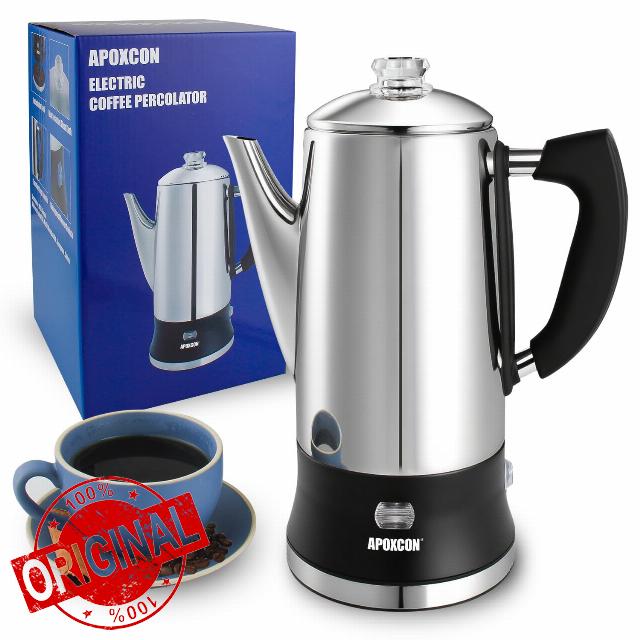
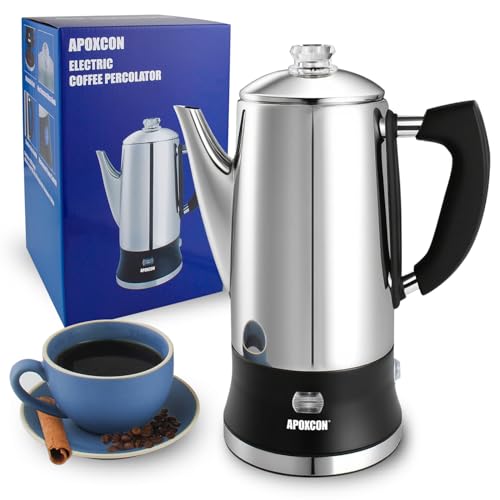
Electric Coffee Percolator Stainless Steel Coffee Maker with Clear Brew Progress Tough Glass Knob and On/OFF Switch Classic Coffee Pot with Keep Warm & Cordless Serve No Aluminum (12 Cup)
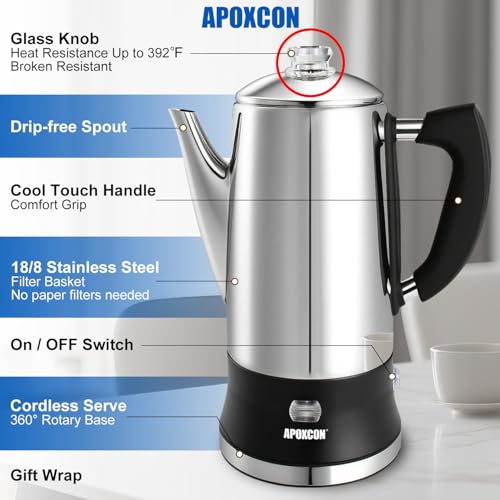
- CAPACITY: Large 12-cup stainless steel percolator perfect for serving multiple people, featuring a durable construction with no aluminum components
- BREWING VISIBILITY: Clear glass knob allows you to monitor the percolation process while your coffee brews to desired strength
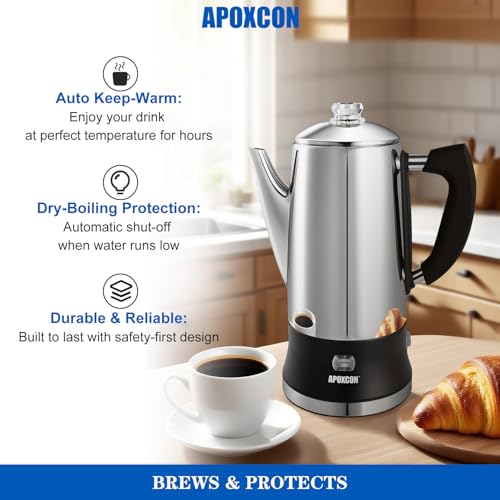
- CONVENIENT FEATURES: Equipped with an easy-to-use ON/OFF switch and automatic keep-warm function to maintain optimal coffee temperature
- CORDLESS SERVING: Detachable base enables convenient, cord-free pouring and serving at the table
- ERGONOMIC DESIGN: Cool-touch handle provides comfortable and safe handling, while the stainless steel body ensures lasting durability
| SKU: | B0FCY5SCKM |
| Weight: | 3.31 pounds |
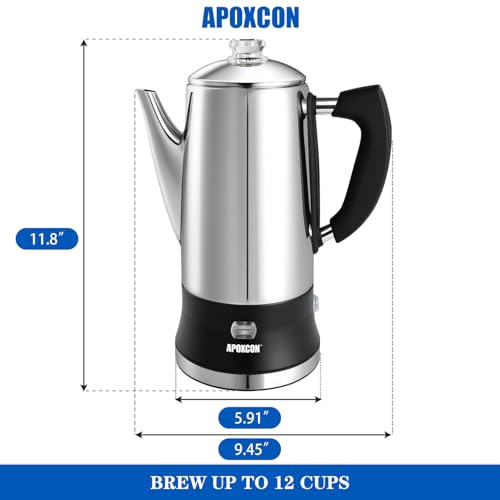
| Dimensions: | 9.57"D x 5.94"W x 13"H |
| Brand: | APOXCON |
| Model: | GM-2 |
| Colour: | Stainless Steel-12 Cup |
| Pack Quantity: | 1 |
| Manufacture: | APOXCON |
| Colour: | Stainless Steel-12 Cup |
| Quantity: | 1 |
Product description

The APOXCON Electric Coffee Percolator is an excellent option for those who enjoy a hot and flavorful coffee every morning. Its modern stainless steel design gives it an elegant appearance that looks great in any kitchen, while its electric operation allows you to prepare coffee quickly and easily.
It stands out for its capacity of up to 12 cups, ideal for families, meetings or for those who drink several cups during the day. In addition, its robust construction and quality materials help maintain the temperature of the coffee for longer.
The clear glass knob on the top is very practical, allowing you to easily see the brewing process and adding a classic, retro coffee pot feel. It heats up quickly and produces rich, flavorful coffee. The keep-warm function is a great bonus, keeping the coffee hot after brewing without it cooling down too fast.
The on/off switch is simple to operate, and once brewing is finished, the cordless design makes serving coffee very convenient. Overall, it’s easy to use and performs reliably.
Shipped by Amazon in a durable corrugated cardboard box containing the APOXCON retail shelf paperboard box holding the coffee maker, the package arrived timely, safely, and undamaged, with contents intact.
I have purchased many coffee makers over the years, and I have an aversion to those with water tanks and pumps. More expensive does not necessarily mean better. Water tanks and pumps are common sources of problems. Not only are they costly, but they are also prone to malfunction and have short lifespans. I prefer an electric coffee maker that is without a water tank and pump.
So far, my favorite coffee maker is the ‘Mr. Coffee BVMC-PO19B All-in-One Pour Over,’ a manual pour-over kit with an integrated scale to automatically calculate the perfect ratio of coffee grounds to water, an integrated hotplate that heats to the optimal coffee brewing temperature, a timer, and an efficient gooseneck water kettle. While there is no keep-warm option and the kettle’s water volume is modest, my only complaint is that I have to pour the water; yet, this also allows me to pour the water more slowly, increasing the brew time, saturation, and coffee strength.
Aside from this, I wish coffee machine manufacturers would stop promoting water capacity in terms of cups and instead specify the volume in ounces. The Specialty Coffee Association of America (SCAA) defines a standard brewing cup as containing 6 ounces and a mug as 12 ounces. This contrasts with Starbucks’ standard coffee cup sizes of 8 ounces for a Short and 12 ounces for a Tall. However, there is no single standard size for a coffee cup, teacup, or mug, as sizes vary by manufacturer, style, and other factors. It is likely that your coffee cups or mugs hold different amounts than these examples, especially since the volume also depends on the fullness of the pour.
Manufacturers have a self-serving motive to advertise a higher “cup” capacity to make their products seem larger and more capable. By defining a “cup” as 5 ounces, a manufacturer can label a 60-ounce pot as a “12-cup” machine. Bear in mind that a portion of the water used for brewing is absorbed by the coffee grounds, so the volume of brewed coffee is always less than the volume of water you pour into the pot; so, fill the pot a bit above the cup mark.
The Amazon “seller” of the APOXCON electric percolator coffee maker is MSG (Manufacturing Service Group), a Chinese company based in Jingmn, Gungdng, China. Its subsidiary, Huiye Hardware & Electrical Equipment Company Ltd., is a division that serves as the group’s research and development and international marketing agent, which holds the APOXCON trademark, while MSG handles broader manufacturing, distribution, and sales. The products are “Fulfilled by Amazon” (FBA), indicating that Amazon manages the storage, packing, and shipping of the seller’s products to customers from its fulfillment centers.
You can view the entire APOXCON product line by clicking on the ‘Visit the APOXCON Store’ blue hyperlink at the top of the page just below any APOXCON product description. At the time I was contemplating, there were seven electric percolator models.
Briefly summarized below in the order of the date when the product came to the marketplace, I have listed the seven electric percolator models that were available as of the date I made my selection:
800 watts
Model Number WEP1800-2 — 12 Cup
Amazon Standard Identification Number — ASIN: B0C9HS4R37
Date First Available: June 27, 2023
1000 watts
Model Number GW-2 — 12 Cup
Amazon Standard Identification Number — ASIN: B0D1CDX943
Date First Available: April 10, 2024
1000 watts
Model Number GW-3 — 8 Cup
Amazon Standard Identification Number — ASIN: B0DJD4YXLM
Date First Available: October 2, 2024
1000 watts
Model Number GW-5 — 10 Cup
Amazon Standard Identification Number — ASIN: B0DY1DR8KX
Date First Available: February 21, 2025
1000 watts
Model Number GW-9 — 10 Cup
Amazon Standard Identification Number — ASIN: B0FCXPDXRG
Date First Available: June 12, 2025
950 watts
Model Number GM-2 — 12 Cup
Amazon Standard Identification Number — ASIN: B0FCY5SCKM
Date First Available: June 12, 2025
1000 watts
Model Number GW-7 — 6 Cup
Amazon Standard Identification Number — ASIN: B0FDVJHFQT
Date First Available: June 20, 2025
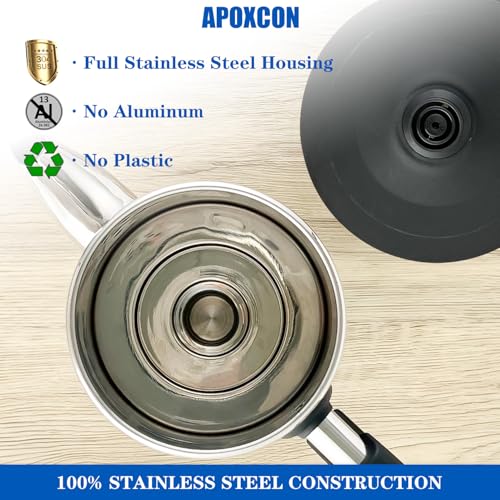
I chose the APOXCON 12-cup, 950-watt, Model GM-2 (ASIN B0FCY5SCKM), which first came to the marketplace on June 12, 2025, primarily because the description states “no aluminum,” and the image of the interior water reservoir does not indicate that the heating element is covered “with black nonstick coating.” This is a new model that is easily recognized from the others by the silver metallic strap around the cordless-serve electric base when viewing the complete lineup of electric percolator coffee makers on the APOXCON Store page, and it is the only model with a stainless-steel heating well.
This model of the 12-cup coffee maker holds 96 ounces (according to the manufacturer’s specifications), based on a true 8-ounce cup, verified by using an 8-ounce measuring cup and filling the pot to the 12-cup mark, which is equivalent to 12 eight-ounce cups, or 16 six-ounce cups, or 8 twelve-ounce mugs, etc.
It is impossible to accurately assess the build quality of this model of the APOXCON electric percolator coffee maker because the description and specifications omit details, such as the gauge and thickness of the SS304 stainless steel components and the type and durability of the plastic base. The specifications list its weight as 3.31 pounds, suggesting a well-balanced design that combines durability with practicality, keeping the unit lightweight for easy lifting and pouring. My unqualified opinion is that the stainless-steel parts are likely 18 gauge, corresponding to a thickness of approximately 0.0478 inches (1.21 mm).
A more significant omission involves the integral heating element, a crucial component in direct and constant contact with the coffee water. Numerous well-known brands generally feature stainless steel pots, but they incorporate aluminum components in the heating well that come into contact with the water during brewing. However, aluminum raises concerns regarding corrosion and imparting a metallic taste. To tackle this, the element is often anodized, or shielded with a ceramic coating, or, in the case of APOXCON, coated with an anti-scale, corrosion-resistant, black nonstick material. This raises concerns regarding the properties of the “black nonstick coating” and its possible PFAS “forever chemicals,” (although these concerns might be irrelevant). Recent developments in coatings suggest that the black nonstick material is probably a modern, high-temperature-resistant silicone-polyester resin, distinct from Teflon (PTFE).
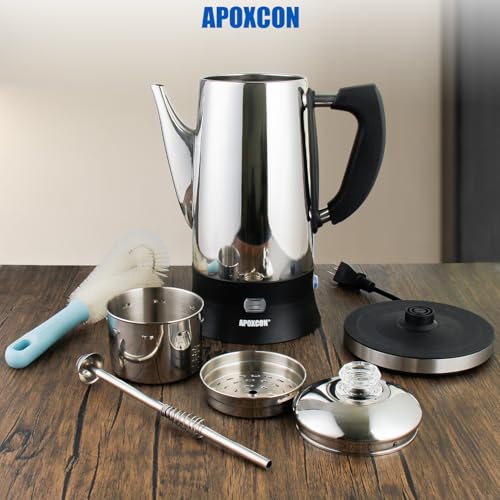
This APOXCON model’s heating element is positioned under its stainless-steel heating well, a cylindrical indentation (or recessed well) in the floor of the water reservoir, allowing the heating element to focus on the small volume of water in this recessed well, generating rapid boiling and steam bubbles that force water up the central pump tube without overheating the entire reservoir volume prematurely. Controlling the heating element is a thermostat, in thermal contact with the recessed well, which allows the thermostat to sense the temperature of the well’s stainless-steel surface (which heats the water) without direct immersion. The thermostat uses a bimetallic strip—two bonded metals that expand and contract at different rates—to monitor the water temperature in the recessed heating well. It starts in a closed position, allowing full power to the heating element for rapid boiling and percolation, then snaps open at a preset threshold (typically 195F for optimal coffee brewing), and switches to a keep-warm mode to prevent over-extraction or boiling dry.
The percolator pump tube, which runs through the grounds basket, features a flared flange, forming a perforated shallow bowl-shaped collar, that seats the pump tube just above its end extending into the recessed heating well. Between this perforated seat and the end of the pump tube is a loose, floating washer. This washer moves up and down within the confines of the heating well, functioning as a one-way check valve. It seals the perforations from inflow during pressure buildup and opens when pressure is relieved, ensuring thermostatically controlled water flow over the heating element.
The sound of the percolation is not the standard rhythmic gurgling; rather, it is a sizzling sound created by a phenomenon known as “flash vaporization,” in which cold water is rapidly vaporized into steam by the superheated metal of the well, resulting in a turbulent expansion of steam. This causes the pump tube’s metal washer to snap open and close under pressure, producing a unique sound. These unfamiliar sounds give the impression that something is wrong. However, rest assured, there is nothing wrong with the percolator.
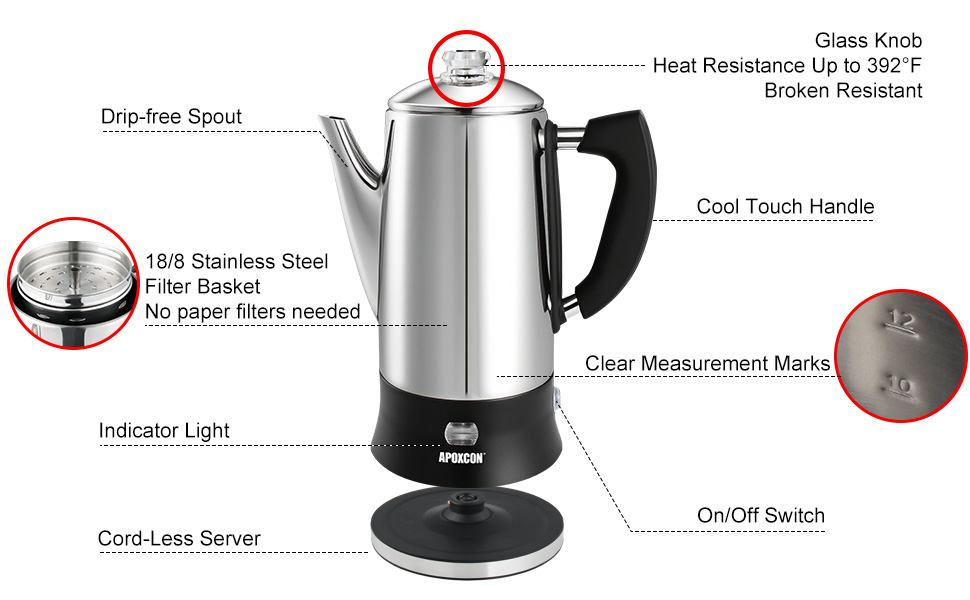
The specifications omit a description, but the carafe’s ‘Stay-Cool’ plastic base is most likely made of ABS (Acrylonitrile Butadiene Styrene), a well-known polymer recognized for its strength, heat resistance, and ability to insulate while withstanding daily impacts. Despite the ‘Stay-Cool’ assurance, it becomes quite hot. The plastic base is securely attached to the stainless-steel carafe, creating a unified structure fastened with tamper-proof Torx security screws threaded through the ABS case and into the stainless-steel base. This plastic base houses the primary electrical components, including the heating element, thermostat, wiring, electrical connections, and controls, which connect to a detachable power base. The power base, also made from the same ABS plastic, features a central pin connection that allows you to remove the carafe to carry and pour coffee without a power cord, providing convenience for serving. The keep-warm function resumes automatically when the pot is placed back on the base.
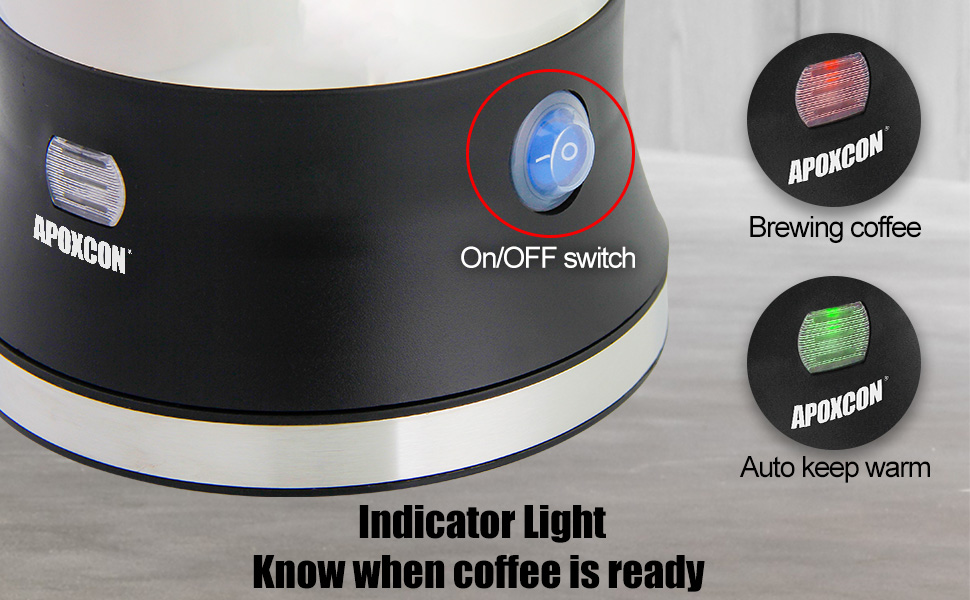
On the right side of the base, just below the carafe handle, is a blue acrylic on-off toggle switch marked with the symbols “I” for ON and “O” for OFF, which lights blue when its backlight LED is activated during operation. A transparent silicone sleeve covers the switch, protecting the internal contact points from moisture and spills. This sleeve is a permanent, integral component that should not be removed, even though it is not snug.
On the front-facing fascia of the base, between the carafe’s pouring spout on the left and its handle on the right, is a single textured acrylic lens-covered LED indicator light. This light glows coral during brewing and turns green when the percolation cycle is complete, signaling that the coffee is ready-to-serve and that the auto keep-warm feature is active. Both the LED power and progress indicator lights turn off when the unit shuts off automatically after the keep-warm mode expires or when the boil-dry auto-shutoff engages for safety if the water runs out during use or if there is no water in the pot. The duration of the keep-warm function is not specified, but in my experience, it never went off until I turned it off. (Note: The manual states the brew light glows green and the keep-warm light glows red; however, the brew light is neither green, red, nor orange—it is coral, a color between red and orange—and the ready-to-serve keep-warm light is green; just the opposite of what the manual says.)
The heat-resistant, tempered borosilicate glass knob, designed to withstand temperatures ranging from 0F to 392F, is a durable, thick, molded glass capable of resisting both heat and minor impacts. The knob’s stem is a threaded screw that passes through the lid, ensuring a tight fit without the need for a washer or a nut to prevent loosening or leakage. Inspect the knob carefully to ensure it is free of manufacturing defects such as air bubbles or hairline fissures, which could cause breakage. Despite its durability, it is still glass and can still break.
Notably, the wattage varies between models, from 800 W to 1000 W. Higher wattage allows for faster brewing but it does not raise the brewing temperature. The brewing temperature is regulated by a thermostat that reduces heat once the water reaches a specific temperature or automatically shuts off if the water completely evaporates. Temperature is an important factor in the extraction of flavor from the coffee grounds: hotter water extracts flavors more quickly, but excessive heat can produce bitterness. Lighter roasts require a temperature near the upper end of the spectrum, around 205F, to fully extract their complex flavors, while darker roasts need a temperature closer to the lower end, approximately 195F, to avoid bitterness. When the coffee reaches the ideal brewing temperature—generally between 195F and 205F, as recommended by the National Coffee Association for optimal flavor extraction—the thermostat activates to stop the brewing process and then shifts to a lower “keep warm” temperature mode.
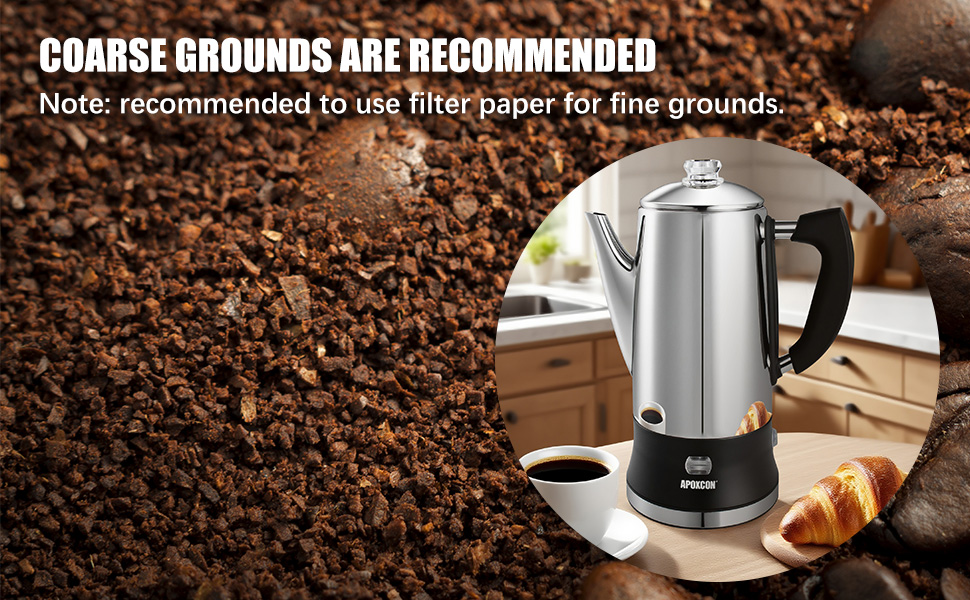
The only way to influence the brew is by adjusting the coffee-to-water ratio without overfilling the grounds basket or changing the grind size. Percolators work by continuously directing heated water up a central tube and over coffee grounds placed in a basket. They require coarse-ground coffee to ensure adequate water flow through the grounds and to prevent clogging of the stainless-steel basket. If the grind is too fine, it becomes compacted, creating a density that restricts water flow during the percolation cycle, causing the basket to overflow and spill. Even a drip grind is too fine.
Take note of the three small steam vents in the lid: a safety feature to release excess steam pressure and prevent dangerous buildup during brewing. However, these vents can cause coffee to leak, seep, or spit if the grounds basket is overfilled or if the coffee grind is too fine, clogging the system and forcing hot coffee water to escape through the safety vents instead of circulating through the grounds. To reduce pressure-driven spills, use a coarse coffee grind to ensure consistent water flow, and avoid overfilling the grounds basket.
Time will reveal whether this choice was wise or merely wishful thinking. I didn’t buy this APOXCON percolator because it was less expensive. I looked at Cuisinart, Presto, Farberware, and others. I chose this APOXCON model because of its construction; the build quality is excellent. I purchased mainly for its stainless-steel heating element because it had no aluminum and no coating on the heating element. This alone sets it above well-known brand names. For now, I am content with my decision, although I wish programmable options existed to adjust the brewing temperature, brewing time, and keep-warm functions.
The ‘Instruction Manual’ is an 8-page monochrome booklet in basic black-and-white text and diagrams on satin paper, constructed by folding two standard sheets of paper with two staples in the center fold. Pages 7 & 8 are blank. The booklet offers no more information than setup, operation, and maintenance. It does not include any warranty or contact information. Keep in mind, you are able to contact the seller, MSG, through your order details on Amazon.com. Log in, go to “Your Orders,” and select “Contact Seller” for issues. If needed, initiate claims via Amazon’s A-to-Z Guarantee for resolution.
I had the opportunity to contact the seller, MSG, through the Contact Seller link on my order. The communication was a form of text messaging through Amazon, and I received a prompt reply through an email notification linked to my Amazon account where the texted response was posted. The experience was very satisfying and reassuring.
Update: I don’t recommend filling to the 12-cup mark, the water touches the grounds basket and impedes circulation.